
Plumbing estimating is the process of calculating a project’s total probable cost — materials, labor, equipment, permits, overhead, and profit — from a quantity takeoff of the scope of work, before a single pipe is cut. A reliable estimate depends on three things: an accurate takeoff, a correctly loaded labor rate, and an honest read of the job-site conditions that will speed the work up or slow it down.

What Is Plumbing Estimating?
Plumbing estimating is the discipline of predicting, in dollars, what a plumbing job will cost to complete — before the contractor is bound to a price. It sits between the design (blueprints, specs, or a homeowner’s description of a problem) and the bid or proposal that goes to the customer. The estimator’s job is to translate scope into quantities, quantities into cost, and cost into a number the business can stand behind.
Done well, an estimate protects both sides of the transaction. It stops a contractor from underbidding a job and eating the loss in labor overruns, and it gives the customer a clear, itemized picture of what they’re paying for instead of a number pulled from experience alone. Done poorly — by guessing at labor hours, using stale material prices, or ignoring the physical realities of the site — an estimate turns into a liability the moment work starts.
At its core, every plumbing estimate rests on three pillars: materials (what it takes to build), labor (what it takes to install), and conditions (what makes the installation faster or slower than the textbook case). The first is largely a pricing exercise. The second and third are where estimating becomes a craft rather than a lookup table.
The Core Components of a Plumbing Estimate
A complete estimate is more than a materials list with a number at the bottom. Whether it’s built in a spreadsheet or dedicated estimating software, it should account for every cost category below.
| Quantity takeoff / materials | Pipe, fittings, valves, fixtures, manifolds, and specialty items, priced at current supplier rates |
| Labor | Man-hours for rough-in, trim-out, testing, and startup, priced at a fully loaded hourly rate |
| Equipment / plant | Excavation, lifts, pumps, specialty tools, and rented equipment |
| Permits & inspections | Jurisdiction filing fees and inspection scheduling built into the timeline |
| Overhead | The business’s fixed costs — office, insurance, vehicles, admin staff — allocated across jobs |
| Profit margin | The markup that makes the job worth taking, applied on top of direct cost plus overhead |
| Contingency / waste | A buffer, typically 5–10%, for material waste, price shifts, and minor unknowns |
| Sales tax | Applied per local requirements, often on materials only |
Materials and equipment costs are relatively mechanical — get a current quote, apply a markup, move on. Labor is where estimates succeed or fail, because labor cost isn’t a fixed number: it’s a rate multiplied by a duration, and both the rate and the duration are shaped heavily by conditions on the job
Estimating Basics | The Step-by-Step Process
Review the scope and walk the site
Read the drawings and specifications, or for service work, walk the property. This is where access conditions, existing pipe material, and code triggers get identified — details that a phone estimate will always miss.
Perform a quantity takeoff
Count and measure everything the job requires: linear feet of pipe by size and material, number of fittings, valves, and fixtures. Missing an item here is the single most common cause of an estimate falling apart mid-job.
Price materials at current rates
Pull pricing from the supplier, not memory — copper, PEX, and PVC pricing shift with commodity markets. Add a small buffer for waste and price movement between bid and build.
Estimate and price labor
Assign man-hours to each phase of work, then apply the fully loaded labor rate (see Section 4). This step must be adjusted for the site conditions covered in Section 5.
Add overhead and profit
Layer the business’s overhead recovery rate and target profit margin on top of the direct costs to arrive at the sell price.
Build in contingency
Add a buffer for the unknowns every estimator eventually runs into — a corroded fitting behind a wall, a permit delay, a change in scope.
Assemble and present the estimate
Compile the internal spreadsheet into a clean, customer-facing document: scope description, total price (itemized or lump sum, depending on the client), payment terms, and license/insurance information.
Calculating Labor Cost
Labor is usually the most volatile line item in a plumbing estimate, and the most misunderstood. Material costs are consistent — a 90-degree PVC elbow costs roughly the same wherever you buy it. Labor is not: the same install can take one hour or three depending on the plumber’s skill, the crew size, and the conditions covered in the next section. Estimators manage that volatility by working from a loaded labor rate rather than a plumber’s take-home wage.
What loaded labor rate means?
A plumber’s hourly wage is only part of what it costs to put them on a job. The loaded (or “burdened”) rate adds every cost of employment that the business carries whether or not the plumber is actively billing:
- Base wage
- Payroll taxes
- Workers’ compensation insurance
- Health benefits and retirement contributions
- Paid leave, holidays, and sick time
- Vehicle, fuel, and tool allowances
- Site allowances or travel pay, where applicable
LOADED LABOR RATELoaded Hourly Rate = Total Annual Cost of Employment ÷ Total Productive Hours per Year
Productive hours, not calendar hours
A full-time employee is paid for roughly 2,080 hours a year (40 hours × 52 weeks). But not every one of those hours is billable, on-the-tools time. Subtract vacation, public holidays, sick days, and training, and a realistic productive-hour figure typically lands closer to 1,700–1,850 hours per year. Dividing total employment cost by calendar hours instead of productive hours is one of the most common ways estimators quietly under-price labor.
A journeyman plumber’s total annual cost to the business — wages, taxes, insurance, benefits, and allowances — comes to $92,000. After subtracting non-productive time, the business gets roughly 1,800 productive hours a year from that plumber.
$92,000 ÷ 1,800 hours = $51.11 per hour loaded labor rate — the true internal cost of an hour of that plumber’s time, before overhead recovery or profit is even applied.
Man-hours and crew productivity
Once the loaded rate is set, the estimator applies it against man-hour units per task — a standard used throughout construction cost data (fixture set, per fitting, per linear foot of pipe by size and material). Two adjustments matter here:
- Crew size doesn’t divide time linearly. Two plumbers rarely finish a task in exactly half the time of one — coordination, shared access to the work area, and sequencing add friction.
- Skill mix changes the average rate. Blending an apprentice’s lower rate with a journeyman’s higher rate without adjusting for the apprentice’s lower productivity understates true cost.

Job-Site Conditions That Change the Price
This is where estimating stops being arithmetic and starts requiring judgment. The same fixture, installed by the same plumber, can take dramatically different amounts of time depending on the conditions surrounding the work. A strong estimator treats “conditions” as its own line of analysis, not an afterthought.
Access conditions
How a plumber physically reaches the work area is one of the biggest labor swing factors on any job
| Condition | Effect on labor |
|---|---|
| Open stud walls (new construction) | Fastest install — full visibility and clearance, minimal repair |
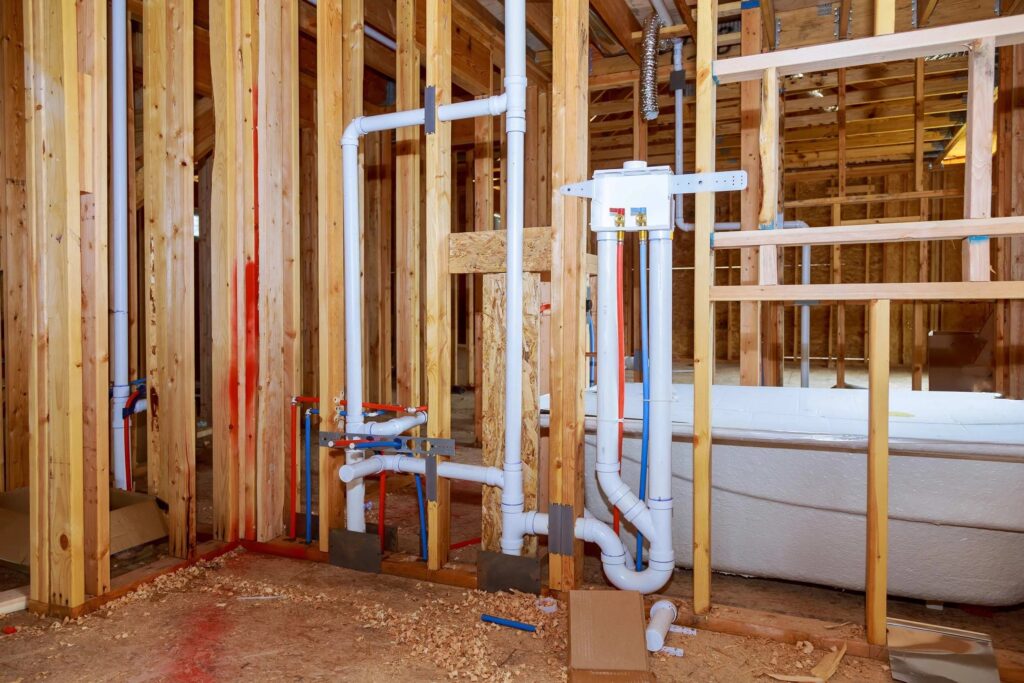
| Finished walls (remodel) | Requires cutting, fishing pipe, and patching/painting after — adds significant hours |
| Slab-on-grade | May require saw-cutting concrete, trenching, and pour-back — heavy labor and equipment cost |
| Crawl space / attic | Confined, awkward positions slow every task and increase fatigue-driven inefficiency |
New construction vs. retrofit or remodel
Retrofit work carries costs that simply don’t exist in new construction: demolition, protecting finished surfaces and furnishings, patch-and-repair after the rough-in, and the constant risk of discovering outdated pipe materials or a layout that doesn’t match the original drawings. As a rule of thumb, the same scope of work in a retrofit commonly runs 20–50% more labor hours than the equivalent install in open framing.
Building type and complexity
Residential, commercial, and industrial plumbing carry different code requirements, inspection sequences, and coordination needs with other trades (electrical, HVAC, fire protection). Commercial and industrial estimates generally require more detailed takeoffs and a higher contingency for coordination delays.
Emergency vs. scheduled work
A burst pipe at midnight and a planned repipe booked three weeks out are priced differently. Emergency and after-hours work typically carries a premium to cover overtime labor rates, disrupted scheduling, and the urgency the customer is paying for.
Building height and material transport
Multi-story work adds time for moving materials, tools, and waste vertically — via stairs, hoists, or elevators — time that a single-story job never incurs.
Occupied-space protection
Working in a home or business that’s still in use adds care and cleanup time: dust barriers, floor protection, and careful scheduling around occupants that an empty new-build site doesn’t require.
Code, permit, and inspection variability
Local plumbing codes, permit turnaround times, and inspection requirements vary by jurisdiction and can add both cost and schedule risk that must be priced into the estimate rather than absorbed after the fact.
Common Plumbing Estimating Mistakes
- Pricing labor at wage rate, not loaded rate — quietly erasing overhead and profit before the job even starts.
- Skipping the site visit and estimating access conditions from a floor plan alone.
- Using stale material prices instead of a current supplier quote.
- Ignoring travel time and mobilization between jobs or to remote sites.
- Forgetting demolition, patching, and cleanup on remodel and retrofit scopes.
- Leaving out permit fees and inspection scheduling risk.
- No contingency line, leaving zero margin for the unknowns behind every wall.

Tools That Help
Most plumbing businesses evolve through three stages of estimating tooling: a simple estimate template for basic jobs, a structured spreadsheet that separates customer-facing pricing from internal cost breakdowns, and eventually dedicated estimating or field-service software that stores historical labor data, current material pricing, and standardized man-hour unit costs. Industry cost-data references are also widely used to benchmark labor-hour assumptions against, especially for commercial and larger-scale work where in-house historical data is limited.
Frequently Asked Questions
What is plumbing estimating?
Plumbing estimating is the process of calculating the materials, labor, equipment, and other costs required to complete a plumbing project. It helps contractors prepare accurate bids, set budgets, and avoid unexpected expenses.
How do you calculate labor cost for a plumbing job?
Labor cost is typically calculated by estimating the number of hours required for the work and multiplying those hours by the applicable labor rate. Factors such as project complexity, crew size, location, and site conditions can also affect the total labor cost.
What job-site conditions most affect plumbing labor cost?
Site access, building layout, project size, working space, existing plumbing conditions, underground work, installation height, and coordination with other trades can significantly affect plumbing labor costs.
Why is retrofit or remodel plumbing work more expensive than new construction?
Retrofit and remodeling projects often require removing existing materials, working around occupied spaces, locating existing plumbing, repairing unexpected conditions, and carefully coordinating new systems with existing ones. These additional tasks can increase labor and material costs.
What should be included in a plumbing estimate?
A plumbing estimate should generally include material quantities and costs, labor hours and rates, fixtures, piping, fittings, valves, equipment, installation costs, subcontractor costs when applicable, permits or related allowances, waste factors, overhead, and markup.
How much should a plumbing estimate be marked up?
Plumbing markup varies depending on the contractor, project type, location, competition, overhead, risk, and desired profit margin. Contractors should calculate their actual overhead and target profit rather than relying on one standard markup for every project.