
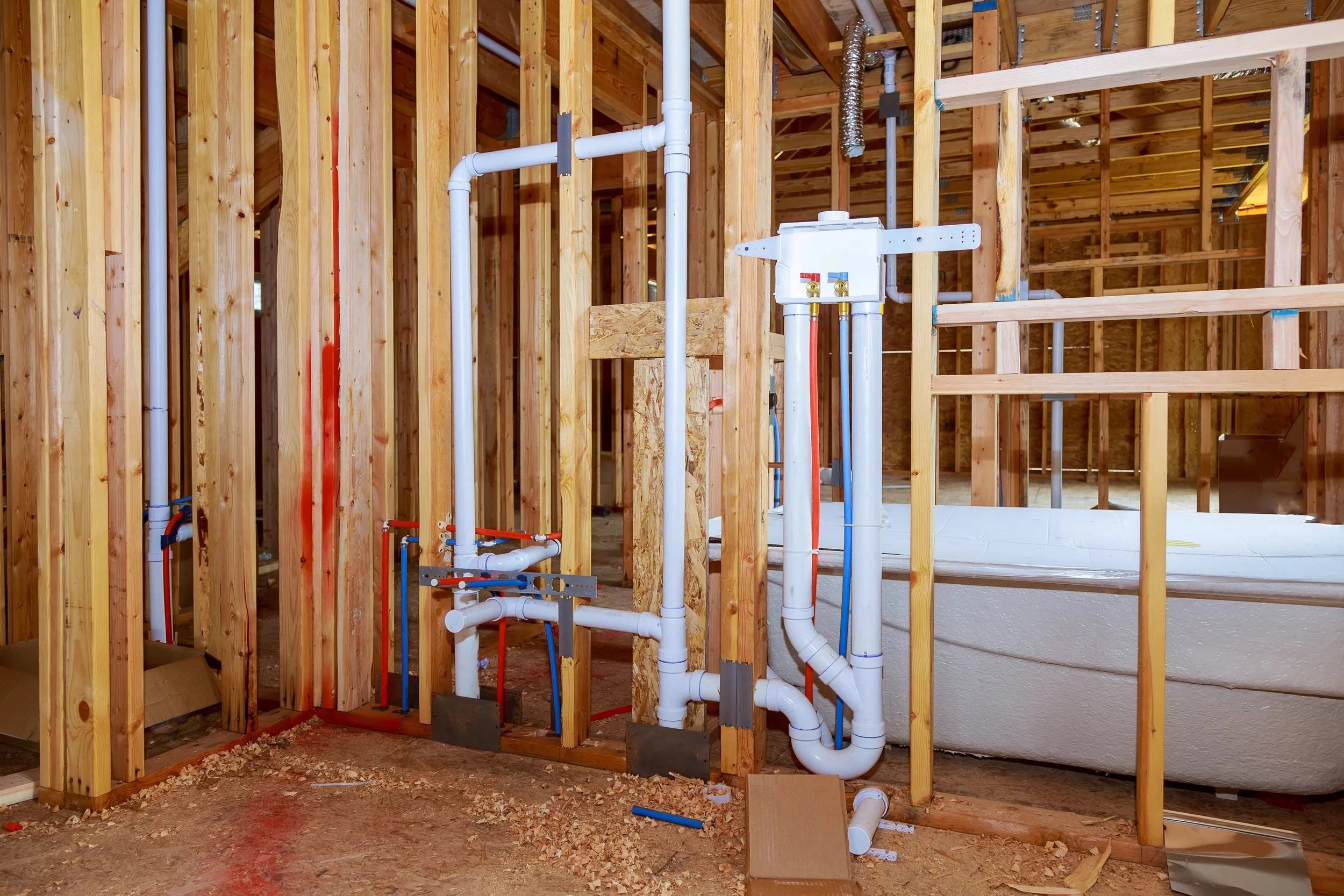
If you have ever opened a plumbing bid and wondered where the final number actually comes from, you are not alone. A plumbing estimate is not a guess, and it is not a flat price per square foot pulled out of thin air. Behind every accurate bid sits a structured process called a plumbing takeoff — a line-by-line count of every fixture, every foot of pipe, and every fitting the drawings call for, converted into material costs and labor hours. In this guide, we break down exactly how plumbing estimates are calculated, element by element, so builders, general contractors, remodelers, and homeowners across Texas can read a bid with confidence — whether the project sits in Harris County, Dallas County, Travis County, Bexar County, Fort Bend County, or a fast-growing suburb like Katy, Frisco, or New Braunfels.
What Is a Plumbing Takeoff?
A plumbing takeoff (also called a material takeoff or quantity takeoff) is the measurement stage of estimating. The estimator studies the plumbing plans, riser diagrams, plumbing schedules, and specifications, then quantifies everything required to build the system: fixtures, pipe by size and material, fittings, valves, hangers, insulation, and equipment. Only after the quantities exist can pricing begin. In other words, the takeoff answers the question ‘how much of what?’ and the estimate answers ‘what will it cost?’
Professional estimators typically perform digital takeoffs using software such as Bluebeam, PlanSwift, Trimble, or FastPIPE, scaling directly from PDF drawings. On design-build or remodel work without complete drawings, quantities are developed from site measurements and standard rough-in rules. Either way, the takeoff is organized by system — sanitary waste and vent, domestic cold water, domestic hot water, gas piping, and storm drainage — and often by construction phase: underground (below slab), rough-in (top-out), and trim (finish).
The Fixture Count — Where Every Estimate Begins
Fixtures are the anchor of a plumbing estimate. The estimator counts every water closet, lavatory, kitchen sink, bathtub, shower, floor drain, hose bibb, washing machine box, ice maker box, water heater, and mop sink shown on the plans, and lists each with its make, model, and mounting type from the fixture schedule. On commercial work this extends to flush valves, drinking fountains, grease interceptors, and backflow preventers.
The fixture count matters for two reasons. First, fixtures themselves carry real cost — a standard builder-grade lavatory faucet and a commercial sensor faucet can differ by hundreds of dollars, so the specification level drives the material budget. Second, fixtures determine the size of everything upstream and downstream of them through fixture unit calculations:
- Drainage Fixture Units (DFU) — a value assigned to each fixture under the plumbing code that determines the required size of drain, waste, and vent piping.
- Water Supply Fixture Units (WSFU) — a demand value used to size water supply piping, the water service, and the meter.
Because most of Texas — including Houston, San Antonio, Austin, and hundreds of smaller jurisdictions — adopts a version of the Uniform Plumbing Code or International Plumbing Code with local amendments, fixture unit tables directly shape pipe sizes, and therefore cost. A house plan with three-and-a-half baths in Fort Bend County simply requires larger drains, more venting, and a bigger water service than a two-bath layout in the same neighborhood, and the estimate reflects that mathematically, not by feel.
A widely used shortcut in residential budgeting is cost per fixture: total plumbing cost divided by the number of fixture openings. In much of Texas, complete rough-plus-trim pricing commonly lands in the range of several hundred to over a thousand dollars per fixture depending on finish level, slab conditions, and market — useful for early budgets, but never a substitute for a full takeoff.
The Pipe Takeoff — Measuring Linear Footage by Size and Material
With fixtures counted, the estimator measures pipe. Every run on the drawings is traced and recorded as linear footage, separated by system, diameter, and material, because each combination has a different unit price and a different labor rate. A takeoff sheet will show entries like: 2″ PVC sanitary — 145 LF; 4″ PVC building drain — 60 LF; 3/4″ PEX cold water — 210 LF; 1/2″ PEX hot water — 180 LF; 3/4″ CSST gas — 90 LF.
Common Pipe Materials and How They Affect Price
- PVC and ABS — the standard for drain, waste, and vent (DWV) piping in Texas residential and light commercial work; inexpensive material with fast solvent-weld labor.
- PEX — dominant for water supply in new Texas homes; low material cost, very fast installation, and forgiving in slab-on-grade construction typical of Houston, Dallas–Fort Worth, and San Antonio subdivisions.
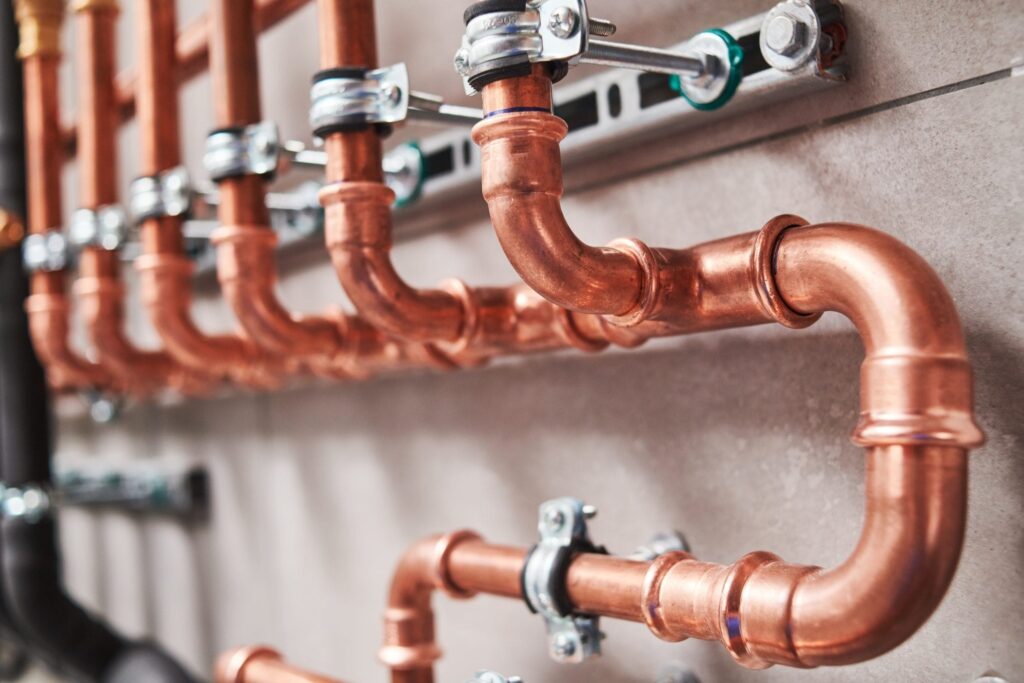
- Copper (Type L/M) — still specified in many commercial projects and high-end custom homes in areas like Highland Park, West University Place, or Alamo Heights; significantly higher material cost and slower soldered or pressed joints.
- CPVC — a mid-priced water supply option still common in parts of the state.
- Cast iron — specified where quiet drainage or fire ratings matter, such as multifamily projects in Austin or Dallas; heavy material and premium labor.
- CSST and black steel — for natural gas distribution, priced per foot plus regulators, shutoffs, and bonding.
Vertical pipe is easy to miss. Risers, stacks, and drops do not always read clearly on a flat plan view, so estimators add measured vertical footage from riser diagrams and known ceiling heights. Most estimators also apply a small waste factor — commonly 5–10% — to cover offcuts and field adjustments.
Underground vs. Above-Ground?
Because slab-on-grade foundations dominate Texas homebuilding, the underground (below-slab) phase is a major cost center. Sanitary lines are trenched, installed, tested, and inspected before concrete is poured. Expansive clay soils across Harris County, Dallas County, Tarrant County, and Bexar County make trenching, bedding, and proper fall critical — and in some soil conditions engineers require special pipe support or flexible connections, all of which show up as line items in a thorough estimate. In the Hill Country around Travis and Comal Counties, rock excavation can add substantial cost to the same underground scope.
Fittings, Valves, and the Small Parts That Add Up
Fittings are where inexperienced estimates fall apart. Every change of direction, branch, and transition needs a fitting: elbows, tees, wyes, couplings, reducers, cleanouts, traps, closet flanges, and adapters. On the supply side add stop valves at every fixture, ball valves at branches, pressure-reducing valves where street pressure runs high, and — increasingly important in Texas — thermal expansion tanks at water heaters where check valves or PRVs create closed systems.
There are two accepted ways to quantify fittings:
- Itemized count — each fitting is counted from the drawings, the most accurate method and the standard on commercial bids.
- Fitting allowance — a percentage added to pipe material cost (often 25–50% depending on system complexity) used for speed on straightforward residential work.
Beyond fittings themselves, a complete takeoff includes the supporting materials that drawings rarely dimension but codes always require: pipe hangers and straps at code-spaced intervals, nail plates, firestopping at rated penetrations, sleeves, pipe insulation on hot water lines where required by the Texas energy code, solvent cement, solder and flux, gas test gauges, and water heater pans, stands, and venting. Individually these are small numbers; collectively they can be several percent of the job.
Turning Quantities into Dollars — Material Pricing
Once quantities exist, each line is priced. Estimators pull current supplier pricing or use cost databases, because plumbing commodities move: copper tracks metal markets, PVC resin pricing shifts with energy costs, and fixture lead times affect price. A bid priced from six-month-old numbers is a bid that loses money. Material subtotals are usually organized by phase — underground, top-out, trim — which also creates a natural payment schedule (a common Texas residential split is roughly a third of value in each phase).
Labor — The Half of the Estimate You Can’t See
Labor typically represents 40–60% of a plumbing bid, and it is calculated, not guessed. The standard method assigns labor units — hours per task — to every quantity in the takeoff: hours per fixture set, per foot of pipe by size and material, per fitting joint, per water heater installation. Multiplying quantities by labor units yields total man-hours; man-hours multiplied by the fully burdened crew rate (wages plus payroll taxes, insurance, and benefits for the licensed plumber-and-apprentice crew) yields labor cost.
Productivity assumptions shift with conditions. Overhead work on lifts, occupied-space remodels, trenching in wet gumbo clay after a Gulf Coast rain, or coordinating around other trades on a tight Austin urban infill lot all reduce output and increase hours. Honest estimates state those assumptions; low bids often quietly ignore them.
Equipment, Permits, Overhead, and Profit
- Equipment and specialty items — water heaters (tank or tankless), recirculation pumps, water softeners common in hard-water regions like San Antonio and the Texas Hill Country, sump or sewage ejector pumps, and gas regulators.
- Permits and inspections — plumbing permit fees vary widely between jurisdictions such as the City of Houston, City of Dallas, City of Austin, unincorporated Montgomery County, and smaller municipalities; each has its own fee schedule and inspection sequence.
- Testing — hydrostatic or air tests on DWV, pressure tests on water and gas lines, all of which carry labor time.
- Overhead and profit — the contractor’s operating costs (vehicles, insurance, office, licensing under the Texas State Board of Plumbing Examiners) plus margin, typically applied as a percentage markup on the direct-cost subtotal.
Why Location Inside Texas Changes the Number
Two identical floor plans can carry noticeably different plumbing costs in different parts of the state, and a good estimate reflects it. Labor rates in the Austin–Round Rock and Dallas–Fort Worth metros run higher than in many smaller markets. Expansive soils around Houston, Sugar Land, Katy, and Mesquite influence underground scope, while rock in Travis, Williamson, and Comal Counties raises trenching cost. Freeze protection details became a bigger line item statewide after the 2021 winter storm, with more attention to insulated lines, attic routing, and hose bibb protection from Lubbock to League City. Coastal exposure in Galveston and Corpus Christi affects material selections, and rapidly growing counties like Fort Bend, Montgomery, Denton, Collin, Williamson, and Hays each layer their own permitting and inspection practices onto the estimate. A takeoff that ignores geography is only half an estimate.
Common Plumbing Estimating Mistakes to Watch For
- Counting fixtures but forgetting the rough-in valves, boxes, and carriers behind them.
- Measuring horizontal pipe on the plan view and missing vertical risers and vent stacks.
- Using a flat fitting allowance on a complex, fitting-heavy layout.
- Pricing copper or PVC from stale supplier quotes in a moving market.
- Ignoring site conditions — soil, rock, groundwater, occupied buildings — in labor hours.
- Leaving out permits, testing, insulation, firestopping, or water heater accessories.
- Comparing bids by bottom line only, without checking whether scope and fixture specifications match.
Frequently Asked Questions
How long does a plumbing takeoff take?
A typical single-family home can be quantified in a few hours by an experienced estimator with digital tools; commercial projects take days depending on drawing volume.
What documents does an estimator need?
Plumbing floor plans, riser/isometric diagrams, fixture schedules, specifications, and the site/civil sheet for the water and sewer service connections.
Is price-per-square-foot reliable for plumbing?
Only for very rough budgeting. Plumbing cost tracks fixture count and layout far more closely than floor area — a small home with four baths costs more to plumb than a large home with two.
Get an Accurate Plumbing Estimate for Your Texas Project
Understanding how plumbing estimates are calculated is one thing — producing a bid-ready takeoff under deadline is another. That is exactly what we do at Texas Estimate. Our estimating team delivers detailed plumbing takeoffs and cost estimates — fixture counts, pipe and fitting quantities, labor hours, and phase-by-phase pricing — for residential, commercial, and multifamily projects across the entire state, from Houston, Dallas, Fort Worth, Austin, and San Antonio to fast-growing communities in Harris, Dallas, Tarrant, Travis, Bexar, Fort Bend, Montgomery, Collin, Denton, and Williamson Counties. Whether you are a plumbing contractor who needs more bids out the door, a general contractor validating subcontractor pricing, or a builder budgeting your next community, send us your plans today and receive an accurate, market-current plumbing estimate you can bid with confidence. Visit Texas Estimate to upload your drawings and get a fast quote.