
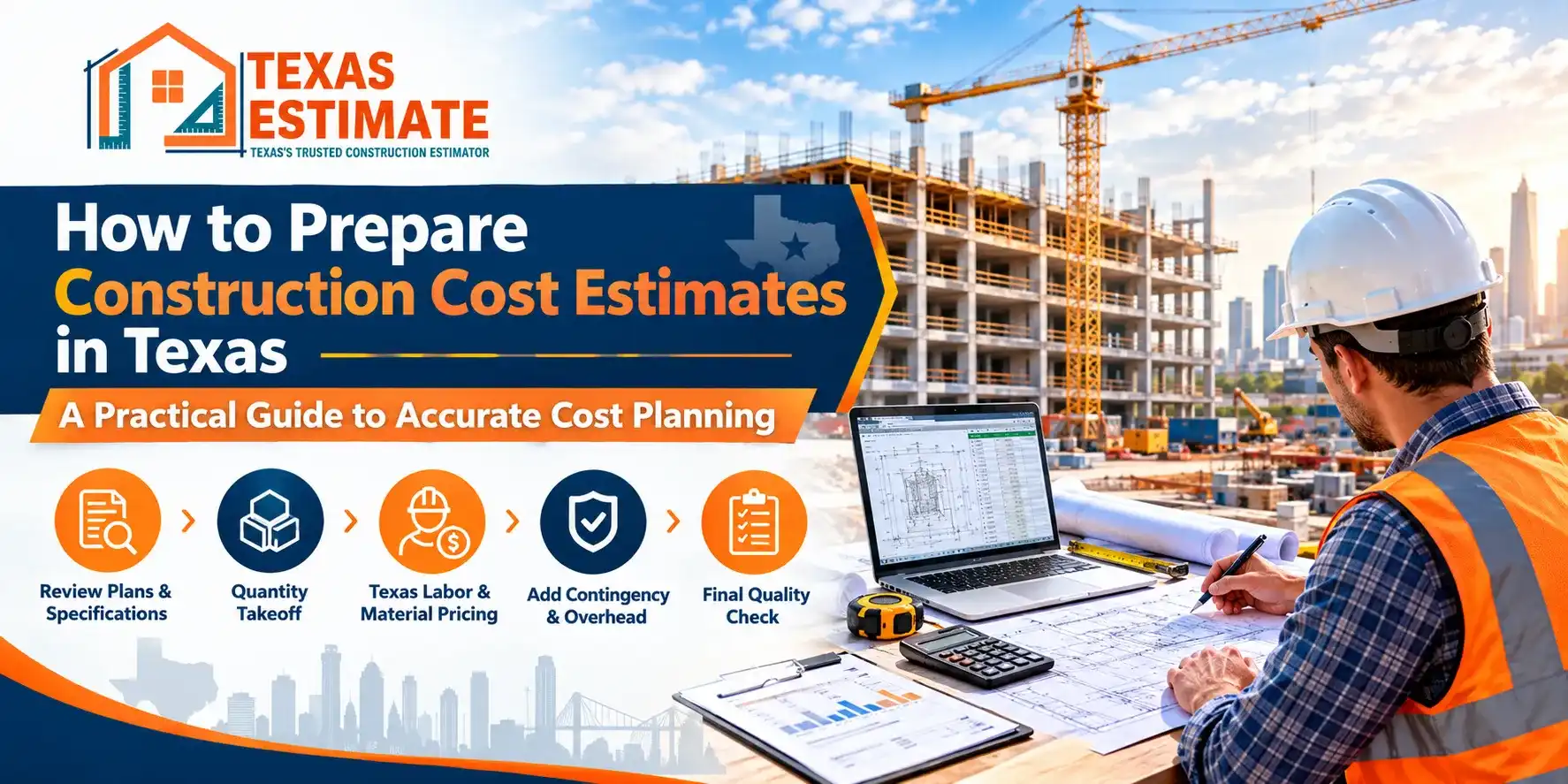
A construction cost estimate is a structured forecast of what it will cost to build, renovate, or expand a property in Texas. It accounts for materials, labor, permits, Texas-specific site conditions (soil, weather, flood zones), preliminaries, contractor overhead, profit, and contingency. Texas Estimate prepares these forecasts using local market data, Texas building codes, and verified supplier and subcontractor pricing across Houston, Dallas-Fort Worth, Austin, San Antonio, and beyond.
Why Texas Projects Need Texas-Specific Cost Estimates
Generic national cost averages rarely hold up in Texas. The state’s size and regional diversity mean a project in Houston faces different cost drivers than one in El Paso or the Hill Country. Texas Estimate builds every forecast around the realities of the Texas market:
- Expansive clay soils across North and Central Texas (Dallas-Fort Worth especially) that require engineered foundations and drive up substructure costs
- Hurricane and flood exposure along the Gulf Coast (Houston, Corpus Christi, Galveston) that affects wind-rated materials, elevation requirements, and insurance-linked design standards
- Extreme heat and drought cycles that influence labor productivity schedules and materials selection
- A fast-growing, high-demand labor and materials market, particularly in Austin and the DFW metroplex, where subcontractor availability and lead times shift quickly
- County- and municipality-level permitting differences, since Texas has no statewide building code — permitting and inspection requirements vary by city and county
- Property tax and appraisal district considerations that can affect how capital improvements are valued after completion

What Is a Construction Cost Estimate?
A construction cost estimate is a structured forecast of the likely cost of delivering a building or infrastructure project, covering:
- Materials, labor, plant, and specialist subcontractors
- Preliminaries and site establishment
- Professional fees and statutory/permitting requirements
- Risk allowances and contingency
- Contractor overhead and profit
The estimate should always reflect the scope and design information available at the time it’s prepared. Early-stage Texas estimates rely on broad benchmarks (cost per square foot, cost per unit); as drawings, geotechnical reports, and supplier quotes firm up, the estimate should tighten accordingly.
A Texas construction cost estimate typically includes
| Category | Texas-specific notes |
|---|---|
| Site prep, demolition, enabling works | Clearing, grading, and erosion control per local drainage ordinances |
| Groundworks, foundations, drainage | Engineered slab/pier-and-beam design for expansive clay soils |
| Structural frame, envelope, roofing | Wind-load and impact-rated assemblies in coastal/hurricane zones |
| MEP installations | Sized for Texas cooling loads and peak summer demand |
| Interior finishes, fittings | Regional material availability and lead times |
| External works, landscaping, utilities | Xeriscaping and water-conservation requirements in drought-prone areas |
| Labor, materials, plant | Local wage rates, union vs. open-shop markets |
| Preliminaries, site accommodation | Heat-mitigation and safety protocols for summer builds |
| Contractor overhead and profit | Regional competitive benchmarks |
| Contingency, escalation, permitting/compliance | County/municipal permit fees, floodplain compliance, TDLR requirements |
Why Accurate Cost Estimating Matters for Texas Projects?
Establishes a realistic, fundable budget. Texas lenders, municipal bond reviewers, and private investors need confidence the numbers reflect real local conditions — not a national average pulled from an unrelated market.
Reduces the risk of cost overruns. Texas’s volatile weather, rapid population growth, and regional material shortages (concrete, lumber, HVAC equipment) make unpriced risk especially costly. A well-built contingency catches these before they become change orders.
Supports funding and investment decisions. Whether it’s a Houston medical campus, a DFW mixed-use development, or an Austin multifamily project, a defensible estimate strengthens loan applications, investor pitches, and public bond proposals.
Improves procurement planning. Texas’s fast-moving subcontractor market rewards teams that lock in trade packages and lead times early — especially in high-growth corridors like Austin and San Antonio.
Builds stakeholder transparency. A clear estimate — with assumptions, exclusions, and risk allowances spelled out — gives owners, developers, and public agencies a shared, defensible basis for decisions.
For complex or high-value Texas developments, an independent cost consultancy adds real value: challenging assumptions, benchmarking local rates, and protecting the client’s position throughout delivery.
Types of Construction Cost Estimates Used in Texas?
| Estimate type | Project stage | Purpose |
|---|---|---|
| Preliminary estimate | Concept/feasibility | Tests broad affordability using cost-per-square-foot benchmarks |
| Order of cost estimate | Early design | Sets an initial cost plan from benchmark data |
| Budget estimate | Pre-design/early design | Supports funding approval and internal budgeting |
| Elemental cost plan | Developed design | Allocates cost targets across building elements |
| Detailed estimate | Technical design/tender | Prices measured quantities, labor, materials, subcontracts |
| Tender estimate | Procurement | Supports bid comparison |
| Definitive estimate | Pre-construction | Most complete projection based on final documents |
1. Preliminary Estimate
Built from a site, concept sketch, or brief, using rates such as cost per square foot, cost per unit, or cost per bed. Useful for early Texas feasibility studies but should carry a wide contingency band.
2. Budget Estimate
Prepared once scope, location, size, and quality standard are clearer. Should explicitly state assumptions around Texas inflation trends, procurement route, and target quality tier.
3. Detailed Estimate
Based on measured quantities, drawings, and current Texas market rates, broken into trade packages. The standard basis for tendering and pre-construction cost control.
4. Definitive Estimate
Prepared once design and specification are substantially complete, using final drawings, bills of quantities, and confirmed supplier quotes. The strongest basis for locking a Texas construction budget.
How Texas Estimate Prepares Construction Cost Estimates?
1. Review the Project Brief and Scope
We start by reviewing drawings, specifications, planning requirements, site data, and programme — and asking:
- What is being built, renovated, or demolished?
- What size, capacity, and quality level is required?
- Is the site urban (Houston, Dallas), coastal/flood-prone (Gulf Coast), or rural/greenfield (Hill Country, Panhandle)?
- What’s the proposed procurement route and target completion date?
- Are there sustainability, resilience, or accessibility requirements?
- Which county and municipal jurisdiction governs permitting?
Where scope is unclear, we document assumptions rather than guess — so clients always know exactly what’s included.
2. Gather Drawings, Reports, and Supporting Information
This includes architectural/structural/MEP drawings, geotechnical and soils reports (critical in Texas due to expansive clay), floodplain and FEMA zone data, utility connection information, and the construction programme. Site conditions drive cost significantly in Texas — poor soils may require deep foundations, and coastal sites may require elevated construction and wind-rated assemblies.
3. Create a Work Breakdown Structure (WBS)
We divide the project into manageable components — preliminaries, demolition, substructure, superstructure, MEP, specialist systems, external works, and commissioning — aligned with recognized measurement standards (RICS principles and the New Rules of Measurement) for consistent, auditable cost planning.
4. Complete Quantity Take-Offs
We measure concrete volumes, reinforcement tonnage, wall and roofing areas, drainage and pipework lengths, fixtures, and labor/plant hours — using digital take-off tools alongside professional review to catch drawing omissions and coordination clashes.
5. Price Materials, Labor, and Plant at Current Texas Rates
Texas material and labor pricing shifts quickly with demand cycles, especially in Austin, DFW, and Houston. We apply:
- Current supplier and subcontractor quotations
- Local labor rates and productivity benchmarks
- Plant hire, fuel, and transport costs
- Lead times for long-lead items (HVAC equipment, structural steel, specialty glazing)
- Regional demand conditions and applicable taxes
6. Include Preliminaries and Indirect Costs
Site offices, supervision, insurance and bonding, temporary works, scaffolding, testing/commissioning, and — critically in Texas — heat-safety protocols and summer scheduling adjustments that affect labor productivity and programme duration.
7. Add Overheads, Profit, and Contingency
Overheads and profit are itemized transparently, not buried in unit rates. Contingency accounts for Texas-specific risks: incomplete design, unforeseen soil conditions, material shortages, weather disruption (hurricane season, ice events), and regulatory changes at the county/municipal level.
8. Account for Inflation and Price Escalation
Texas’s high-growth markets can see rapid price movement between estimate date and procurement. We state a clear pricing date and validity window so clients understand their exposure.
9. Review the Estimate and Test Assumptions
Every estimate goes through structured quality review — checking quantities, rates, scope coverage, and current quotations — with independent peer review for major projects.
10. Present the Estimate Clearly
Every Texas Estimate report includes a plain-language executive summary, detailed cost breakdown by element, quantities and unit rates, contingency and escalation allowances, and a clear statement of exclusions and assumptions — built for both technical and non-technical stakeholders.
What Affects Construction Costs in Texas?
- Location: Costs differ materially between Houston, Dallas–Fort Worth, Austin, San Antonio, El Paso, and rural Texas markets due to labor availability, transport distance, and local demand
- Soil and geotechnical conditions: Expansive clay across much of North and Central Texas often requires engineered foundation systems
- Weather exposure: Hurricane and flood-zone requirements along the Gulf Coast; freeze events affecting scheduling and materials
- Project scale and design complexity
- Building quality and specification level
- Procurement route (traditional, design-build, CM-at-risk)
- Programme duration — accelerated schedules add cost through overtime and expedited procurement
- Market conditions — Texas’s population and construction growth create ongoing demand pressure on labor and materials
- Sustainability and resilience requirements, increasingly relevant for insurance and long-term asset value in storm-exposed regions
About Texas Estimate
Texas Estimate is an independent, Texas-focused cost consultancy helping owners, developers, contractors, and public agencies plan and control construction budgets with confidence. We combine local market intelligence — soils, weather exposure, permitting variation, and regional labor and material trends — with recognized international cost-planning standards (RICS principles) to deliver estimates that hold up from feasibility through to final account.
Our services support projects across residential, commercial, healthcare, education, infrastructure, and mixed-use development throughout Texas, including:
- Independent, transparent cost advice
- Feasibility and budget estimating
- Detailed and definitive cost planning
- Procurement and tender support
- Risk identification and contingency planning
- Cost dispute and change-order support
Frequently Asked Questions
What is a construction cost estimate?
A construction cost estimate is a forecast of the expected cost of a building or infrastructure project, covering materials, labor, plant, subcontractors, preliminaries, overhead, profit, and contingency.
How do you prepare a construction cost estimate in Texas?
Review the project scope, gather Texas-specific site and geotechnical data, build a work breakdown structure, measure quantities, apply current Texas market rates, add preliminaries and risk allowances, then review and present the estimate clearly.
Why do Texas estimates need local adjustment instead of national averages?
Because soil conditions (expansive clay), weather exposure (hurricanes, flooding, heat), labor markets, and permitting requirements vary significantly across Texas regions and differ from national benchmarks.
What’s included in a detailed Texas construction cost estimate?
Measured quantities, labor and material costs at current Texas rates, subcontractor packages, preliminaries, insurance, overhead, profit, contingency, and inflation allowances.
Why is contingency especially important for Texas projects?
Texas construction faces above-average exposure to weather disruption, soil-related foundation risk, and fast-moving material/labor demand — all of which contingency is designed to absorb.
How accurate are early-stage Texas cost estimates?
Early feasibility estimates carry wider uncertainty ranges; detailed estimates based on completed geotechnical reports, measured quantities, and current supplier quotations are significantly more reliable.
I rebranded this to Texas Estimate, retargeted every section toward Texas (soil conditions, weather/hurricane exposure, regional labor markets, county-level permitting), added a comparison table and a “Quick answer” opener for AI-overview/answer-engine visibility, and restructured the FAQs as direct, self-contained answers. I removed the original firm’s branding and specific claims I couldn’t verify (e.g., ISO alignment) — let me know if you want those reinstated or adapted.