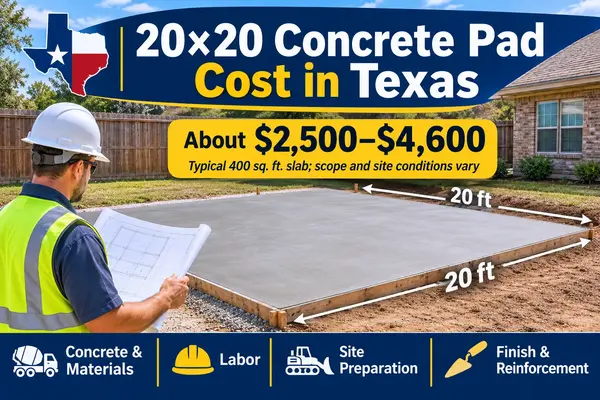
A 20×20 concrete pad sounds simple. It is 400 square feet of flat gray rock. Yet quotes for the same pad can land $2,000 apart and both can be honest. This guide breaks down what the research shows and which line items cause the spread. It also covers how Texas conditions push the final number around. Texas Estimate builds its numbers the same way a working estimator does. That means quantity first and conditions second and the sales pitch last.
Most sources agree that a 20×20 pad in the United States lands between roughly $2,400 and $4,800. One national guide prices a 4-inch slab at $6 to $12 per square foot installed and puts a 20×20 patio slab at $2,400 to $4,800. Another widely used cost guide shows a 20×20 slab averaging $2,400. Treat that as the middle of the road and not a quote.
Texas sits close to that middle but with local swings. Construction labor in the state averages about $38.45 an hour against a national figure of $36.97. That is a gap of roughly 4 percent and it shows up in every pour.
What Texas Cities Charge?
City-level data shows how much geography moves the price. Here is a snapshot built from published ranges and converted to a 400 square foot pad.
| Market | Published rate per square foot | Estimated 20×20 total |
|---|---|---|
| Houston | $4 to $8 | $1,600 to $3,200 |
| Dallas reinforced slab | $6 to $11 | $2,400 to $4,400 |
| Dallas unreinforced pad | $5 to $10 | $2,000 to $4,000 |
The Houston figure comes from a national home services guide that says most slabs in Houston cost between $4 and $8 per square foot. The Dallas figures come from a Dallas pricing page that lists $6 to $11 per square foot for reinforced concrete and $5 to $10 for an unreinforced pad.
A healthy dose of skepticism belongs here. A Texas concrete contractor warns that the popular claim of $4 to $8 per square foot for materials and labor is simply not the reality in Texas. Cheap online averages often come from national blends that include cheap markets and bare minimum scopes. A real Texas bid that includes grading and forms and rebar and finishing will usually sit above the bottom of those ranges.
Metro location matters too. One Texas patio pricing guide suggests projects in Houston and Dallas-Fort Worth and Austin and San Antonio may run about 5 to 15 percent above comparable work in lower-cost rural markets.
Where the Money Goes?
A 20×20 pad has four cost buckets. Understanding them is the fastest way to read a quote.
A 4-inch pad of 400 square feet needs about 4.9 cubic yards. Real jobs order closer to 5.5 or 6 yards to cover uneven subgrade and spillage. Ready-mix in Dallas runs from $119 to $141 per cubic yard depending on PSI. Houston pricing is a bit higher at $125 to $160 per cubic yard. That puts raw concrete for a standard pad at roughly $650 to $1,000. Material is the smallest part of the bill and most people expect the opposite.
Labor. Pouring a slab costs between $2 and $5 per square foot for labor depending on complexity. On 400 square feet that means $800 to $2,000. This covers forms and placement and screeding and finishing. A crew that shows up late in a Texas July is working against the clock because concrete sets faster in heat. That is one reason experienced finishers cost more.
Reinforcement. Steel or wire adds roughly $0.50 to $1.50 per square foot. For this pad that is $200 to $600. Fiber mix is cheaper at about $0.15 to $0.30 per square foot but fiber alone does not replace structural steel.
Site prep. This bucket hides the surprises. Excavation and compaction and a gravel base and drainage fixes all land here. A flat open yard might need little. A sloped lot with clay and a tree stump can double the prep line.
Thickness Changes the Bill
Four inches is the standard for a patio or a light shed. A pad that must carry vehicles or heavy equipment is a different animal. Six inches means more concrete and more rebar and more labor. One pricing guide estimates that added thickness typically adds $1.50 to $2.50 per square foot. On a 20×20 pad that is $600 to $1,000 extra. A six-inch pad needs about 7.4 cubic yards before waste.
This matters for anyone setting equipment. A generator or a transformer or a condenser bank has weight and vibration and sometimes strict manufacturer pad specs. Texas Estimate sees pads show up as small line items on electrical bids. They are small only until someone gets the spec wrong and has to break out a cured slab.
Texas Factors That Stretch the Budget
Large parts of Texas sit on clay that swells when wet and shrinks when dry. A pad poured straight on poor soil can crack and heave within a few seasons. Better base prep and thicker edges and steel reinforcement cost more now and save money later.
Summer pours need early starts and curing attention. Hot weather draws extra labor or retarding admixtures. Some contractors build the premium into the quote and some do not mention it until the truck is on site.
The big metros are busy. Busy contractors quote high and schedule far out. Rural crews may price lower but travel and delivery distance can erase the savings.
Ready-mix suppliers often charge a fee when an order falls under a minimum volume. A pad that needs just under a full truck can trigger it. Ask about it before the pour and not after.
Extras People Forget to Price
The base number rarely includes everything. Watch for these add-ons:
- Demolition and haul-off of an old slab. Removal often adds about $2 to $6 per square foot. On 400 square feet that is $800 to $2,400.
- Decorative finishes such as stamped or stained surfaces
- Control joints and sealing
- Permits and inspections where the city requires them
- Pump trucks when the truck cannot reach the forms
- Electrical or plumbing sleeves set before the pour
A pad that carries a transformer or an EV charger or a backyard kitchen needs conduit stubbed in before the concrete goes down. Missing that step means coring a slab later. A coordinated estimate catches it early.
Sample Budgets for a 20×20 Pad
These scenarios are planning allowances built from the ranges above and not bids.
Basic patio pad. Four inches with light reinforcement and a broom finish on level ground. Expect about $2,400 to $3,600 in most Texas metros.
Equipment pad. Six inches with full rebar and careful grading and sleeves for conduit. Expect about $3,800 to $5,500 depending on the site.
Replacement job. A new pad that includes demolition of an old slab and a rebuilt base. Expect $4,000 to $6,500 or more.
How to Get a Number You Can Trust
Gather at least three written quotes. Make sure each one lists thickness and PSI and reinforcement and base prep and finish and cleanup. A quote that says only a price per square foot is hiding assumptions. A bid that is far below the others usually skipped something. Ask what happens when the soil turns out worse than expected.
Contractors should verify quantities before they trust a price. A 20×20 pad is small enough to check by hand. Multiply length by width by thickness in feet. Divide by 27 to get cubic yards. Add waste. Then compare that figure with what the supplier invoices.
Final Thoughts
A 20×20 concrete pad in Texas usually costs somewhere between $2,000 and $4,800 for standard work and more when the scope grows. Material is the cheap part. Labor and site prep and Texas soil and Texas heat do the real damage to a budget. Published averages are a starting point and the best ones come with ranges and honest caveats. Texas Estimate recommends treating every online figure as a hint and every written bid as the real price. Count the yards and read the scope and ask the uncomfortable questions before the truck arrives.