
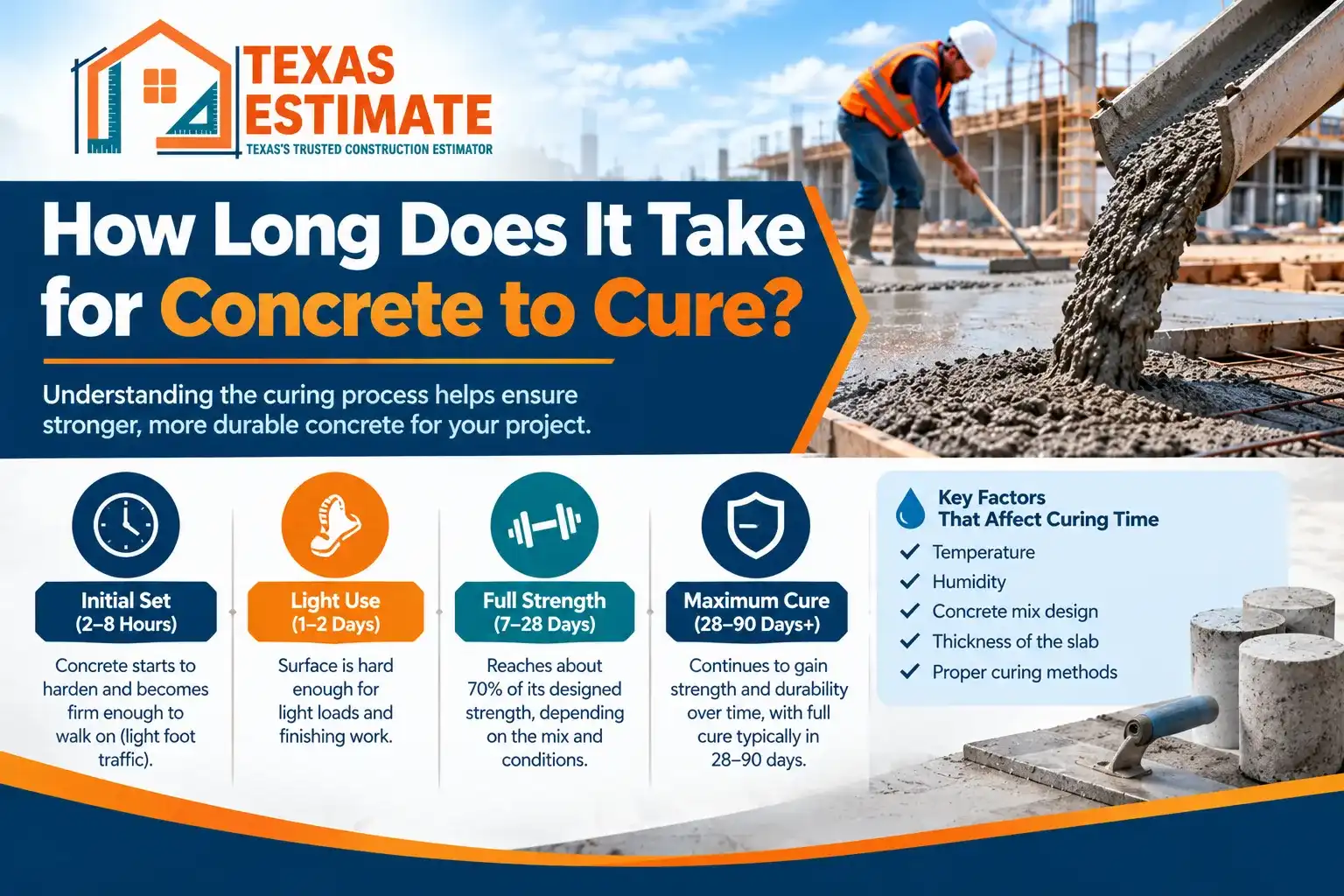
Concrete takes about 28 days to reach its full design strength. It hardens enough to walk on in 24-48 hours, and it can handle light vehicles after about 7 days. Curing doesn’t stop after 28 days, though. Concrete keeps slowly gaining strength for months or even years if moisture remains available.
Concrete Curing Timeline at a Glance
| Time After Pouring | Approx. Strength Reached | What You Can Do |
|---|---|---|
| 2-6 hours | Initial set begins | Finishing, troweling, and edging only |
| 24-48 hours | ~16-25% | Light foot traffic; remove forms (non-structural) |
| 3 days | ~40-50% | Normal foot traffic; light tools |
| 7 days | ~65-70% | Passenger cars; resume heavier activity |
| 14 days | ~85-90% | Most light construction loads |
| 28 days | ~99% (design strength) | Heavy vehicles, equipment, sealing, staining |
| Months to years | 100%+ | Continues gaining strength with moisture |
Concrete Setting vs. Curing vs. Drying | What’s the Difference?
People often use these words interchangeably, but they describe different processes.
Setting is when the mix goes from plastic and workable to rigid. It usually takes 4-8 hours, and initial set occurs before final set.
Curing is the chemical reaction called hydration. Cement particles react with water to form calcium silicate hydrate (C-S-H) crystals, the “glue” that gives concrete its strength. Curing needs water, so keeping concrete moist is part of the process.
Drying is simply water evaporating. Drying isn’t curing. Concrete that dries out too early stops hydrating and ends up weaker, more porous, and prone to cracking.
The Stages of Concrete Curing
1- Initial Set (0-8 Hours)
After pouring, the surface remains workable for a few hours. Finishers screed, float, and trowel the surface during this window. Bleed water rises to the top and must evaporate before final finishing.
2- Final Set and Early Hardening (8-48 Hours)
The slab turns rigid. Most 4-inch slabs support light foot traffic after 24-48 hours, but the interior is still gaining strength rapidly and the surface is vulnerable to scratches, spalling, and indentation.
3- Rapid Strength Gain (Days 3-7)
Hydration is most active here. By day 7, concrete typically reaches around 65-70% of its design strength. Moisture control is most critical in this period.
4- Full Design Strength (Days 7-28)
Strength continues climbing to the 28-day benchmark used in engineering specifications and lab testing (typically via cylinder compression tests under ASTM C39).
5- Long-Term Maturation (Beyond 28 Days)
Concrete doesn’t suddenly stop at day 28. With adequate moisture and unhydrated cement remaining, it can continue to strengthen for years, which is why older structures can test stronger than their original rating.
Factors That Affect How Long Concrete Takes to Cure
1. Temperature
Hydration speeds up in warmth and slows in cold.
| Temperature | Effect on Curing |
|---|---|
| Below 4°C (40°F) | Curing slows dramatically; protect with insulating blankets |
| Near freezing / below 0°C (32°F) | Fresh concrete can freeze and suffer permanent damage if it hasn’t gained enough strength |
| 10-21°C (50-70°F) | Ideal range for steady, strong curing |
| Above 32°C (90°F) | Fast evaporation, rapid set, and risk of plastic shrinkage cracks |
2. Humidity and Moisture
High humidity helps concrete retain water. Dry, windy, or sunny conditions pull moisture from the surface and can ruin curing. Many standards, such as ACI 308, recommend keeping concrete moist for at least 7 days when using standard Portland cement.
3. Water-Cement Ratio
A lower water-cement ratio yields stronger concrete, but it needs careful placement. Too much water makes the mix easy to pour but weakens the final product and increases shrinkage.
4. Cement Type and Mix Design
- Type I (general purpose): standard timeline
- Type III (high early strength): gains strength faster, often used in cold weather or fast-track projects
- Fly ash or slag blends: slower early strength gain but better long-term durability
- Admixtures: accelerators speed up setting; retarders slow it for hot weather
5. Slab Thickness and Mass
Thicker pours generate more internal heat (the exothermic reaction), which can speed curing at the core but create temperature differentials that cause cracking in massive pours.
6. Surface Exposure
Direct sun, wind, and drafts all increase evaporation and require extra protection.
How Long to Wait Before Using Concrete
| Project / Activity | Typical Wait Time |
|---|---|
| Walking on a new slab | 24-48 hours |
| Removing forms (walls, footings) | 24-48 hours (check structural requirements) |
| Placing furniture or light items | 3-7 days |
| Driving a passenger car on a driveway | 7 days (many contractors recommend 10) |
| Heavy trucks, RVs, equipment | 28 days |
| Building on a foundation or footing | Typically 7 days, sometimes longer per engineer |
| Applying sealer | Usually 28 days (breathable sealers sometimes sooner; check the label) |
| Staining or painting | 28 days; some products require pH or moisture tests |
| Installing flooring over a slab | Often 30-60+ days, after moisture testing |
| Setting fence or mailbox posts | 24-72 hours before attaching loads |
How Long Does Fast-Setting Concrete Take to Cure?
Rapid-setting mixes, such as those used for fence posts and repairs, can set in 20-40 minutes and often carry light loads within 1-4 hours. They still gain strength over days, but they are formulated for speed rather than maximum long-term performance. Always follow the manufacturer’s instructions.
How Does Weather Change Concrete Curing Time?
Cold Weather Curing
Below 10°C (50°F), hydration slows. Near or below freezing it can nearly stop. Concrete that freezes before reaching roughly 500 PSI can be permanently damaged.
Cold-weather tips:
- Use insulated curing blankets
- Warm the mixing water or aggregates
- Use accelerating admixtures or high-early-strength cement
- Avoid pouring on frozen ground
Hot Weather Curing
Above 32°C (90°F), water evaporates quickly, causing plastic shrinkage cracks, reduced final strength, and difficulty finishing.
Hot-weather tips:
- Pour early in the morning or in the evening
- Use retarding admixtures and chilled water or ice in the mix
- Use windbreaks and sunshades
- Start curing immediately after finishing
Rain
Light rain after the surface has set usually isn’t a problem, but heavy rain on a fresh surface can wash out cement paste and ruin the finish. Cover fresh pours when rain is forecast.
How to Cure Concrete Properly
- Water curing (ponding or spraying): Keep the surface continuously wet. This is the gold standard for strength.
- Wet coverings: Cover with damp burlap, cotton mats, or sand, and keep them wet.
- Plastic sheeting: Cover with polyethylene to trap moisture and prevent evaporation. Secure the edges.
- Curing compounds: Spray or roll on a liquid membrane that seals in moisture, convenient for large slabs.
- Insulated blankets: Used in cold weather to hold in hydration heat.
Practical routine for a DIY slab: Start curing as soon as the surface can be touched without marring, usually a few hours after finishing. Keep it moist for at least 7 days, longer in dry or hot conditions.
Common Concrete Curing Mistakes
- Letting the slab dry out quickly, especially in sun and wind
- Adding extra water to the mix for easier pouring
- Driving on it too early, which causes cracks and surface damage
- Sealing too soon, which traps moisture and can cause hazing or peeling
- Ignoring weather forecasts
- Skipping control joints, leading to random shrinkage cracks
- Removing forms too early
How Do You Know Concrete Is Fully Cured?
- Lab testing: Compressive strength tests on cylinders (e.g., 7-day and 28-day breaks) are the most reliable method.
- Rebound hammer (Schmidt hammer): A non-destructive field estimate of surface hardness.
- Maturity method: Uses temperature history to estimate strength.
- Color and hardness: Cured concrete turns from dark gray to a lighter, even gray. This is a visual hint only, not proof.
- Moisture tests: For flooring installs, calcium chloride or relative humidity probe tests confirm the slab is dry enough.
Frequently Asked Questions
How long does concrete take to dry vs. cure?
Surface drying can happen in 24-48 hours, but curing continues for 28 days or more. A rule of thumb: concrete takes about a month to dry per inch of thickness in some conditions, which matters for flooring installs.
Can you walk on concrete after 24 hours?
Usually yes, for light foot traffic on a standard slab at moderate temperatures. In cold weather, wait longer.
Can I drive on concrete after 3 days?
It’s risky. Most contractors recommend waiting at least 7 days for passenger vehicles and 28 days for heavy loads.
Does concrete cure faster in hot weather?
It sets and gains early strength faster, but curing too fast can reduce final strength and cause cracks. Moisture retention is crucial.
Does rain hurt curing concrete?
Light rain after the surface has hardened is usually fine. Heavy rain on a fresh surface can damage it. Cover the pour if rain is expected.
Is concrete fully cured after 28 days?
It reaches its specified design strength, around 99%, at 28 days, but it continues to strengthen slowly afterward.
How long before I can seal concrete?
Generally 28 days for film-forming sealers. Some breathable or penetrating sealers allow earlier application. Follow product instructions.
How long does concrete take to cure in winter?
It can take noticeably longer, and below about 4°C (40°F) strength gain slows significantly. Insulation and heated enclosures help.
Should I water new concrete?
Yes. Light misting or wet coverings for 7 days improves strength and reduces cracking, especially in warm or windy conditions.
How long does a concrete foundation take to cure?
Typically 7 days before framing begins, with full strength at 28 days. Your engineer’s specifications take priority.