
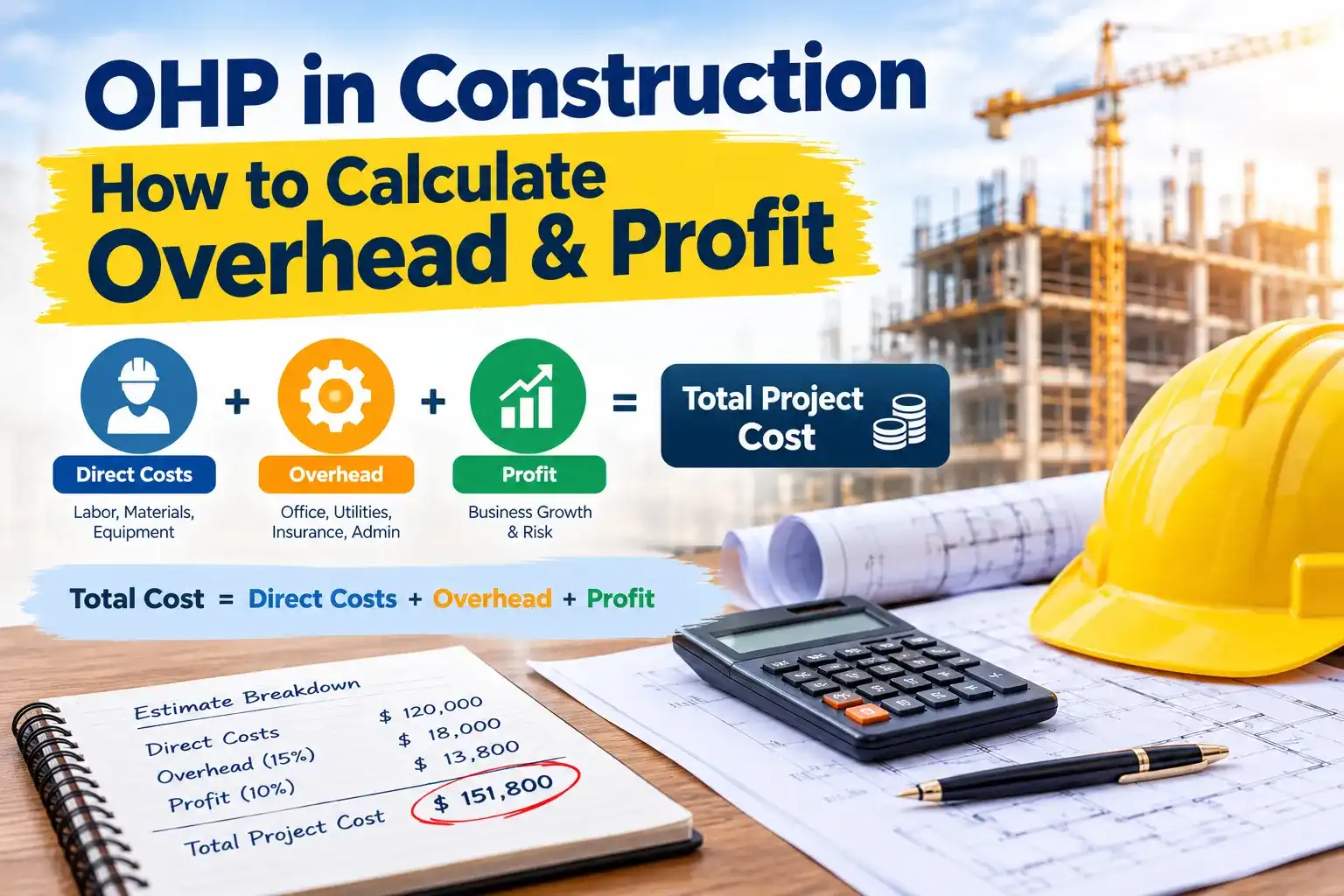
What Is OHP in Construction?
OHP stands for Overhead and Profit. It is the percentage a contractor adds on top of direct project costs (labor, materials, equipment, subcontractors) to cover the indirect costs of running the business and to earn a return. In many U.S. contracts and insurance estimates it is written as O&P. A common benchmark is “10 and 10” (10% overhead plus 10% profit), but the right figure depends on your actual costs, project type, and market.
Why OHP Matters for Texas Contractors?
Texas is a large, varied construction market. A bid in Houston faces different conditions than one in the Rio Grande Valley, Lubbock, or the Dallas–Fort Worth area. Labor rates, material availability, weather exposure, and subcontractor competition all vary by region.
A bid that covers direct costs but ignores overhead can win the job and still lose money. Texas contractors commonly face:
- Regional price swings in lumber, steel, concrete, and electrical and HVAC equipment.
- Weather risk, including Gulf Coast storms, North Texas hail, and extreme summer heat that slows productivity.
- Fast growth, which keeps labor demand and wages under pressure in metros like Austin, Dallas, Houston, and San Antonio.
- Payment and lien rules. Texas Property Code provisions on prompt payment and mechanics’ liens affect cash flow, so confirm the details for your contract type with a construction attorney.
Overhead and profit absorb these pressures. A realistic OHP keeps the business solvent when a project runs long or costs shift.
Overhead vs. Profit-What Each One Covers
| Item | What it is | Examples |
|---|---|---|
| Direct costs | Costs tied to one specific project | Materials, field labor, equipment rental, subcontractors, permits |
| Job-site overhead | Project-specific support costs | Site supervisor, temporary utilities, portable restrooms, dumpsters |
| General (indirect) overhead | Business-wide costs spread across all jobs | Office lease, estimators, accounting, insurance, software, advertising, vehicles |
| Profit | The return after all costs are covered | Reinvestment, risk reserve, owner income |
The source material grouped overhead into operations, labor, and equipment. A clearer split for pricing is job-site overhead (charged to the project) versus general overhead (allocated across all projects). Whichever labeling you use, count every cost once and never skip the indirect ones.
How to Calculate Overhead in Construction?
Total your annual overhead. Add up non-project expenses from the past months: rent, admin wages, insurance, utilities, software, marketing, vehicles, and professional fees.
Total your annual direct costs. Add the materials, field labor, equipment, and subcontractor costs from your jobs in the same period.
Divide overhead by direct costs.
Overhead rate = Annual overhead ÷ Annual direct costs
Apply the rate to new bids.
Overhead for a bid = Direct costs × Overhead rate
Example
- Annual overhead: $60,000
- Annual direct costs: $300,000
- Overhead rate: $60,000 ÷ $300,000 = 20%
On a new job with $100,000 in direct costs, add $20,000 of overhead to reach a cost base of $120,000.
How to Calculate Profit and Profit Margin?
The core formulas are simple:
Total cost = Direct costs + Overhead
Profit = Contract price − Total cost
Profit margin (%) = Profit ÷ Contract price × 100
Example-Profit Margin
| Line | Amount |
|---|---|
| Contract price | $10,000 |
| Materials and labor (direct costs) | $7,000 |
| Overhead | $2,000 |
| Total cost | $9,000 |
| Profit ($10,000 − $9,000) | $1,000 |
| Profit margin ($1,000 ÷ $10,000) | 10% |
In this example the overhead rate on direct costs is $2,000 ÷ $7,000, or about 28.6%. The overhead rate and the profit margin use different bases, so don’t mix them.
Markup vs. Margin – A Costly Mix-Up
- Markup is calculated on cost.
- Margin is calculated on price.
If your total cost is $9,000 and you want a 10% margin, the price is $9,000 ÷ (1 − 0.10) = $10,000. If you only add 10% markup, the price is $9,900, which is a margin of about 9.1%.
The gap grows with larger percentages. A 25% markup equals only a 20% margin. When you quote a “profit target,” always say which one you mean.
What Is a Good Profit Margin in Construction?
There is no single correct number. Margins differ by trade, project size, delivery method, risk, and market conditions. The original article cited a figure of roughly 7% from a 2026 industry survey as an average starting point. I could not verify that figure, so confirm it against the original report before publishing, and present it as context, not a target.
A better approach for Texas contractors:
- Calculate your break-even point (direct costs plus full overhead).
- Set a profit target that reflects the risk of the job, such as scope uncertainty, tight schedules, or volatile materials.
- Check it against recent bids and local competition.
- Revisit it at least yearly.
Scope changes, inflation, and weather delays all erode profit, so build contingency into the estimate instead of hoping to absorb them.
Complete Bid Pricing Example
Using a hypothetical $200,000 in direct costs, a 20% overhead rate, and a 10% target margin:
| Step | Calculation | Result |
|---|---|---|
| Direct costs | Given | $200,000 |
| Overhead (20%) | $200,000 × 0.20 | $40,000 |
| Total cost | $200,000 + $40,000 | $240,000 |
| Price for 10% margin | $240,000 ÷ 0.90 | $266,667 |
| Profit | $266,667 − $240,000 | $26,667 |
This example is illustrative only. Use your own costs and rates.
Common OHP Mistakes to Avoid
- Forgetting indirect overhead such as insurance, software, and admin payroll.
- Using a copied “industry percentage” instead of your own overhead rate.
- Mixing up markup and margin.
- Double-counting costs in both direct and overhead lines.
- Never updating the rate as the business grows or costs rise.
- Skipping contingency on projects with unclear scope or volatile material prices.
- Relying on rough takeoffs. Overhead and profit are applied to your direct costs, so an inaccurate quantity takeoff throws off the whole price.
How Accurate Estimating Supports Better OHP
OHP is only as reliable as the direct-cost estimate underneath it. Detailed quantity takeoffs and current local pricing for materials, labor, and equipment let you apply your overhead and profit percentages to a trustworthy number. Texas Estimate provides construction cost estimating and takeoff services for contractors across Texas, including Houston, Dallas–Fort Worth, Austin, San Antonio, El Paso, Corpus Christi, and the Rio Grande Valley. Contractors can use those direct-cost figures as the base for their own overhead and profit.
Frequently Asked Questions
What does OHP mean in construction?
OHP means Overhead and Profit. It is the percentage added to direct project costs to cover indirect business expenses and earn a profit. It is also commonly written as O&P.
Why do contractors include OHP in their bids?
Overhead costs such as office staff, insurance, technology, and vehicles don’t appear on any single job but must still be paid. Including OHP lets the contractor stay solvent and profitable.
Does OHP sometimes mean “overhead projector” in a construction contract?
In contracts, estimates, and change orders, OHP almost always means overhead and profit. “Overhead projector” is an unrelated meaning from other settings. If a document is ambiguous, check the definitions section or ask the other party to clarify.
How do project scope changes affect a contractor’s profit margin?
Added work without a matching price adjustment lowers margin, because direct costs and overhead rise while the contract price stays the same. Written change orders that include overhead and profit protect the margin.
Can a contractor use a fixed standard OHP percentage for every project?
It’s possible, but not advisable. Project size, risk, duration, location, and trade all change the true cost of doing the work. A standard percentage is a starting point and should be adjusted to the job.
How do professional cost estimation services help control OHP?
They provide detailed takeoffs and current pricing for direct costs, so the overhead and profit percentages are applied to an accurate base instead of a guess.
What is a typical overhead rate for contractors?
It varies widely, so there’s no reliable universal number. Calculate yours: annual overhead divided by annual direct costs.
Conclusion
OHP is how a construction business pays for itself and grows. Calculate your overhead rate from real numbers, keep markup and margin straight, and apply both to an accurate direct-cost estimate. For help with accurate takeoffs and estimates anywhere in Texas, contact Texas Estimate for a quote.