
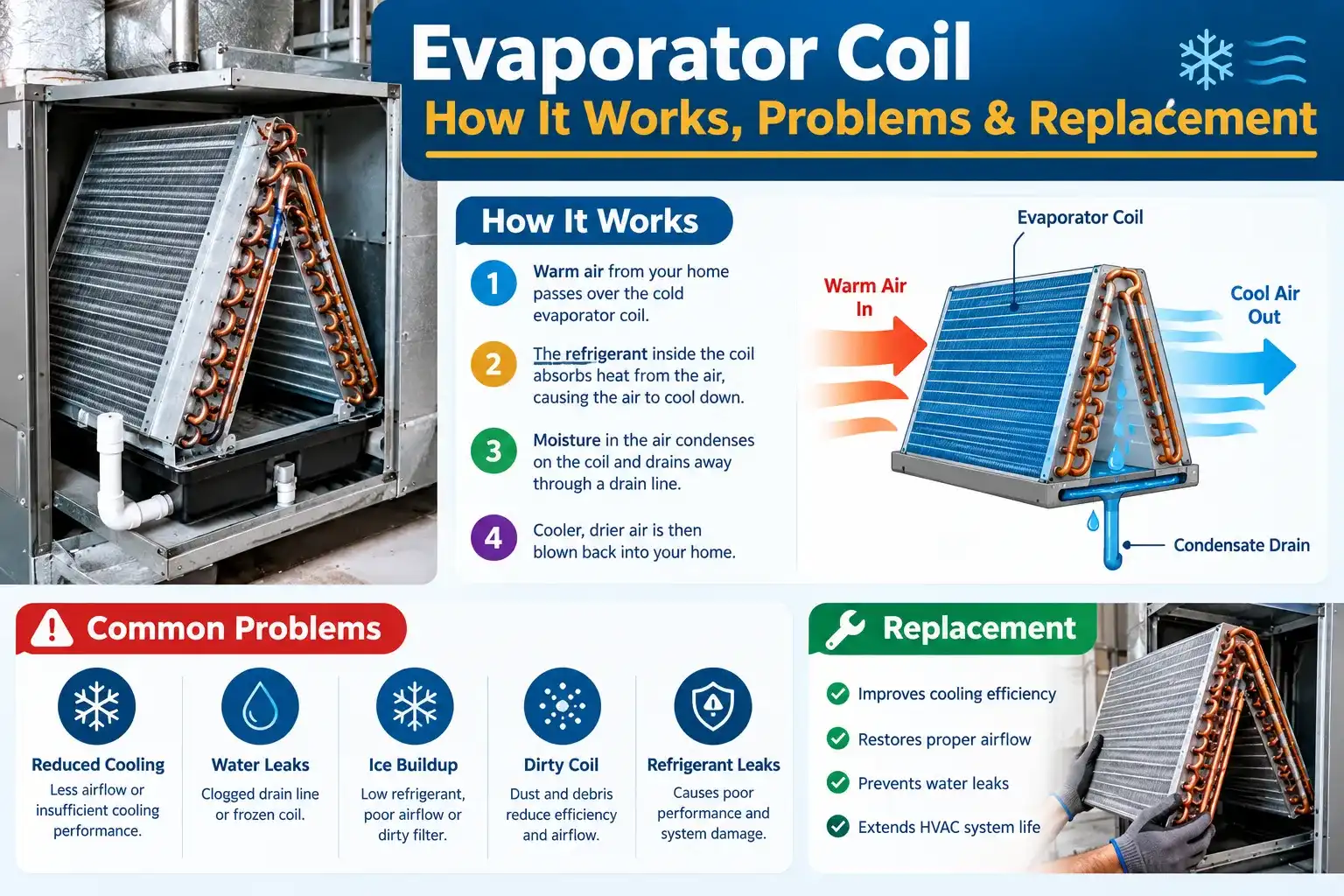
What Is an Evaporator Coil?
An evaporator coil is the indoor heat-absorbing part of vapor-compression cooling systems—air conditioners, heat pumps, refrigerators, and freezers—where low-pressure liquid refrigerant boils (evaporates) as it pulls thermal energy from the surrounding air or fluid. Its name reflects this phase change: heat uptake from the airstream causes the refrigerant inside the coil to transition from liquid to vapor, enabling continuous heat removal from the conditioned space.
How it fits into the cooling cycle
In a standard split air-conditioning system, the evaporator sits on the indoor side (in the air handler or furnace cabinet), while the condenser coil resides outdoors and performs the opposite job: rejecting the absorbed heat pl
How Does an Evaporator Coil Work?
The evaporator coil operates as part of the refrigeration cycle. Understanding the cycle makes it easier to understand what the coil actually does.
A basic cooling cycle involves four major components:
- Compressor
- Condenser coil
- Expansion device
- Evaporator coil
The process generally follows this sequence:
The Compressor Raises Refrigerant Pressure
The compressor receives low-pressure refrigerant vapor from the evaporator and compresses it into a higher-pressure, higher-temperature vapor.
The refrigerant then travels toward the condenser.
The Condenser Releases Heat
The condenser coil rejects heat from the refrigerant to the outdoor environment.
As heat is removed, the refrigerant changes from a high-pressure vapor into a high-pressure liquid.
The Expansion Device Reduces Pressure
The liquid refrigerant passes through an expansion device, such as a thermostatic expansion valve or another metering device.
The pressure and temperature of the refrigerant decrease.
Refrigerant Enters the Evaporator Coil
The cold, low-pressure refrigerant enters the evaporator coil.
Indoor air is moved across the coil by a blower or fan. Because the refrigerant is colder than the air, heat moves from the indoor air into the refrigerant.
The refrigerant absorbs that heat and evaporates.
The Refrigerant Returns to the Compressor
After absorbing heat, the refrigerant leaves the evaporator as a vapor and returns to the compressor.
The cycle repeats.
Simple Evaporator Coil Process
Warm indoor air → evaporator coil → heat transferred to refrigerant → cooler air supplied to room
This is why the evaporator coil is sometimes described as the indoor cooling coil.
What Does an Evaporator Coil Do?
The primary function of an evaporator coil is to transfer heat from air or another medium into the refrigerant.
However, its role involves more than simply lowering air temperature.
Removes Sensible Heat
Sensible heat is the heat that causes a measurable change in temperature.
When warm indoor air passes over the cold evaporator coil, heat transfers from the air to the refrigerant.
The result is cooler supply air.
Removes Latent Heat
An evaporator coil can also remove moisture from humid air.
When warm, humid air encounters a sufficiently cold coil surface, water vapor can condense into liquid water.
That water collects in the drain pan and is discharged through the condensate drainage system.
Therefore, an evaporator coil contributes to both:
- Temperature control
- Humidity control
Transfers Heat Efficiently
The coil is engineered to provide substantial heat-transfer surface area within a relatively compact space.
Fins surrounding the tubing increase the surface available for heat exchange.
Supports Overall System Efficiency
The condition of the evaporator affects airflow, heat transfer, cooling capacity, and system operation.
Experimental research has found that evaporator fouling can have a particularly significant impact because dirt accumulation increases pressure drop and restricts airflow.
Where Is the Evaporator Coil Located?
In a conventional split air-conditioning system, the evaporator coil is normally located inside the indoor air handler or furnace/coil cabinet.
Common locations include:
- Above or below an indoor furnace
- Inside an air handler
- Within a central AC indoor cabinet
- Inside a ducted heat-pump system
- Inside a mini-split indoor unit
- Inside refrigeration equipment
The exact configuration depends on the equipment design.
An A-coil, for example, consists of two angled coil sections that form an approximate “A” shape. This design is common in residential HVAC systems because it provides substantial heat-transfer area within a compact cabinet.
Recent HVAC research continues to examine airflow and pressure characteristics around A-coil evaporator configurations, demonstrating that coil geometry and installation can influence airflow behavior and system performance.
Main Parts of an Evaporator Coil
Although designs vary between manufacturers and applications, a typical evaporator coil may include several important components.
Coil Tubing
Copper or aluminum tubing carries refrigerant through the heat exchanger.
The refrigerant absorbs heat while moving through the tubing.
Fins
Thin metal fins surround or connect with the tubing.
Their purpose is to increase the effective heat-transfer surface area.
Headers
Headers distribute refrigerant between different sections of the coil.
Refrigerant Connections
These connect the evaporator assembly to the rest of the refrigeration circuit.
Drain Pan
In air-conditioning applications, moisture may condense on the coil.
The drain pan collects this water and directs it toward the condensate drain.
Cabinet
The coil is often enclosed within an air handler, furnace cabinet, or dedicated evaporator cabinet.
Types of Evaporator Coils
Evaporator coils come in different designs and configurations.
A-Coil Evaporator
An A-coil has two angled coil sections forming an “A.”
It is widely used in residential central air-conditioning systems.
Advantages
- Compact design
- Large heat-transfer area
- Fits efficiently inside HVAC cabinets
- Common replacement configuration
2. N-Coil
An N-coil uses a geometry resembling the letter “N.”
This configuration can provide a large heat-transfer surface while fitting within particular equipment dimensions.
3. Slab Coil
A slab coil is arranged more like a flat panel.
It can be used in various air-handling and HVAC configurations where cabinet dimensions make a flat coil practical.
4. Cased Evaporator Coil
A cased evaporator coil comes inside a manufactured enclosure.
The casing can simplify installation and provide an organized transition between the coil and surrounding HVAC equipment.
5. Uncased Evaporator Coil
An uncased coil is supplied without a complete outer cabinet.
These coils may be useful when the installer needs to integrate the coil into an existing furnace or air-handler configuration.
6. Mini-Split Evaporator Coil
Mini-split indoor units contain compact evaporator heat exchangers.
The coil absorbs heat from indoor air while the indoor blower distributes cooled air into the room.
7. Refrigeration Evaporator Coil
Commercial refrigeration systems use evaporators designed specifically for applications such as:
- Walk-in coolers
- Freezers
- Display cases
- Cold storage
- Food processing
- Industrial refrigeration
The design depends on the required temperature range, airflow, humidity, refrigerant, and cooling load.
Evaporator Coil vs. Condenser Coil
One of the most common HVAC questions is the difference between the evaporator and condenser coils.
| Feature | Evaporator Coil | Condenser Coil |
|---|---|---|
| Typical location | Indoor | Outdoor |
| Main function | Absorbs heat | Rejects heat |
| Refrigerant state | Generally evaporates through the coil | Generally condenses through the coil |
| Air interaction | Cools indoor air | Releases heat outdoors |
| Moisture removal | Can produce condensate | Normally not the primary moisture-removal component |
| Common problem | Freezing, dirt, restricted airflow | Dirt, blocked airflow, overheating |
The two coils perform opposite parts of the heat-transfer process but depend on each other for the system to operate properly.
What Causes an Evaporator Coil to Get Dirty?
Evaporator coil contamination is usually associated with particles entering the indoor air stream.
Common causes include:
- Dirty or missing air filters
- Poor filter fit
- Filter bypass
- Dusty indoor environments
- Construction dust
- Pet hair and dander
- Poor duct sealing
- Inadequate maintenance
- Excessive airborne particles
- Moisture combined with accumulated dirt
Research from Lawrence Berkeley National Laboratory found that filter efficiency and indoor particle concentration are important factors influencing evaporator coil fouling, while filter bypass and duct/coil design can also matter.
What Happens When an Evaporator Coil Is Dirty?
A dirty evaporator coil can cause more than an unpleasant appearance.
Dirt accumulates between fins and across the coil surface, increasing resistance to airflow.
That can lead to:
- Reduced airflow
- Reduced cooling capacity
- Increased blower workload
- Reduced system efficiency
- Longer operating cycles
- Poor temperature control
- Coil icing in some conditions
- Increased system stress
A peer-reviewed study found that evaporator fouling primarily affected cooling performance through increased pressure drop and reduced airflow.
Another experimental study found that covering 30% of the evaporator coil surface in a ductless split system reduced cooling capacity by approximately 19.1% under the tested conditions. These laboratory results should not be interpreted as a universal percentage for every HVAC system, but they demonstrate how restricted coil surface area can affect performance
Why Is My Evaporator Coil Freezing?
A frozen evaporator coil is a common HVAC problem.
You may notice:
- Ice on the indoor coil
- Frost around refrigerant lines
- Weak airflow
- Water dripping after the ice melts
- Poor cooling
- An AC running continuously
- Warm air coming from supply vents
Several problems can contribute to coil freezing.
1. Restricted Airflow
A clogged filter, blocked return, dirty blower, dirty evaporator coil, or duct restriction can reduce airflow across the coil.
Insufficient airflow can interfere with normal heat transfer.
Research has established that adequate airflow across an evaporator is important for residential air-conditioning performance.
2. Low Refrigerant Charge
A refrigerant leak or improper charge can alter evaporator operating conditions and potentially contribute to abnormal coil temperatures.
However, adding refrigerant without finding the underlying cause is not a complete repair if the system has a leak.
3. Dirty Coil
A heavily contaminated coil can restrict airflow through the fins.
4. Blower Problems
A weak, malfunctioning, or incorrectly configured blower can reduce airflow.
5. Metering Device Problems
An improperly functioning expansion or metering device can affect refrigerant flow into the evaporator.
6. Very Low Indoor Load or Operating Conditions
Under certain conditions, the system can operate outside its intended range, contributing to coil icing.
Important
If an evaporator coil repeatedly freezes, simply removing the ice does not solve the underlying problem. The airflow, refrigerant circuit, blower, filter, metering device, and operating conditions should be evaluated.
Signs of a Bad Evaporator Coil
A damaged or deteriorating evaporator coil can produce several symptoms.
Reduced Cooling
The system runs but does not cool the space effectively.
Longer Cooling Cycles
The air conditioner may operate for unusually long periods.
Warm Air From Vents
Insufficient cooling can result from coil, refrigerant, airflow, compressor, or control problems.
Ice or Frost
Ice around the evaporator or suction line can indicate airflow or refrigerant-related issues.
Water Leaks
A clogged condensate drain, damaged drain pan, frozen coil, or other drainage problem can cause water around the indoor unit.
Refrigerant Leak
Corrosion, mechanical damage, manufacturing defects, or deterioration can result in refrigerant leakage.
Corrosion
Corrosion can eventually compromise coil tubing.
Unusual Odors
Dirt, moisture, biological growth, and stagnant condensate around an indoor coil can contribute to unpleasant odors.
A research study examining fouled evaporator coils found biological material, including Aspergillus fungi, in sampled coil fouling. This does not mean every dirty coil contains harmful biological growth, but it illustrates why moisture and accumulated contamination deserve attention.
Evaporator Coil Cleaning | Why It Matters
Regular HVAC maintenance should include inspection of the evaporator coil when appropriate.
Cleaning helps remove:
- Dust
- Dirt
- Pet hair
- Debris
- Organic deposits
- Other accumulated contaminants
A clean coil allows air to pass through the intended fin passages more easily.
Research indicates that cleaning contaminated coils can restore much of the pressure-drop and heat-transfer performance under tested conditions.
However, coil cleaning is not simply about making the fins look clean.
A proper service procedure should consider:
- Coil accessibility
- Fin condition
- Airflow
- Drain pan condition
- Condensate drainage
- Refrigerant circuit condition
- Filter condition
- Blower operation
- Electrical safety
- Manufacturer requirements
How to Clean an Evaporator Coil
For professional HVAC maintenance, a typical process may include:
1-Turn Off Equipment Power
The system should be safely de-energized before service.
2-Inspect the Coil
The technician examines the coil for dirt, corrosion, bent fins, ice, leaks, and other visible problems.
3-Protect Surrounding Components
Cleaning should prevent water and cleaning chemicals from reaching electrical components or areas not designed for moisture.
4-Remove Accumulated Debris
Appropriate coil-cleaning methods are selected according to the equipment and contamination.
5-Clean the Fins
The technician carefully cleans the coil without unnecessarily bending or damaging the fins.
6-Inspect the Drain Pan
The pan should be checked for debris, corrosion, cracks, and drainage problems.
7-Check the Condensate Drain
A blocked drain can cause water to back up around the indoor equipment.
8-Restore and Test the System
After cleaning, the system should be returned to operation and evaluated for proper airflow and cooling performance.
Can You Clean an Evaporator Coil Yourself?
Some basic HVAC maintenance can be performed by homeowners, especially regular air-filter replacement according to the equipment and filter manufacturer’s instructions.
However, accessing and cleaning an indoor evaporator coil can require opening HVAC equipment and working around electrical components, refrigerant circuits, condensate systems, and delicate fins.
Professional service is particularly appropriate when:
- The coil is heavily contaminated
- The coil is frozen
- There is suspected refrigerant leakage
- The system requires refrigerant recovery or charging
- The coil needs to be removed
- There is corrosion
- Water is leaking
- Electrical components must be accessed
Refrigerant handling also has safety and regulatory considerations. The U.S. EPA notes that refrigerants can present hazards including toxicity, flammability, asphyxiation, and physical risks depending on the refrigerant and equipment.
Evaporator Coil Refrigerant Leak
A refrigerant leak is one of the more serious evaporator-coil problems.
Potential indications include:
- Repeated coil freezing
- Reduced cooling
- Longer operating cycles
- Hissing or bubbling sounds in some circumstances
- Oil residue near a leak
- Low refrigerant pressure
- Poor temperature difference
- Repeated need for refrigerant charging
A technician should diagnose the source rather than treating refrigerant as something that is simply “used up.”
If the evaporator itself is leaking, possible solutions include:
- Leak repair where technically appropriate
- Coil replacement
- Replacement of associated components
- Refrigerant recovery and proper recharge according to applicable requirements
EPA regulations define service involving removal of an evaporator as major maintenance, service, or repair for applicable refrigerant-containing appliances under Section 608 terminology.
Evaporator Coil Repair vs. Replacement
Whether a coil should be repaired or replaced depends on the actual failure.
Repair may be considered when
- The problem is accessible and repairable
- The damage is limited
- The coil remains structurally sound
- Repair is technically appropriate
- The repair can provide reliable service life
Replacement may be considered when
- The coil has extensive corrosion
- Multiple leaks exist
- Tubing is severely damaged
- The coil is repeatedly leaking
- Compatible replacement parts are available
- Repair is impractical
- The coil has reached the end of its useful service life
The decision should be based on the coil’s condition, equipment age, compatibility, refrigerant, labor requirements, expected remaining service life, and overall HVAC condition.
How Long Does an Evaporator Coil Last?
There is no single guaranteed evaporator-coil lifespan.
Actual longevity depends on:
- Coil material
- Refrigerant
- Indoor humidity
- Air quality
- Filter maintenance
- Coil cleanliness
- Corrosive environments
- Installation quality
- Operating hours
- Maintenance practices
- Manufacturing design
Research from Lawrence Berkeley National Laboratory estimated that typical residential evaporator coils could accumulate enough fouling to approximately double pressure drop in roughly 7–11 years under studied conditions, while the expected physical life of an evaporator coil was discussed as approximately 15–30 years. Importantly, fouling life and physical component life are not the same thing.
That distinction is useful: a coil can remain structurally intact while its performance is impaired by dirt.
Factors That Affect Evaporator Coil Efficiency
Several variables influence evaporator performance.
Airflow
Insufficient airflow can significantly affect cooling performance.
Coil Cleanliness
Dirt increases airflow resistance and can reduce system performance.
Refrigerant Charge
Correct refrigerant conditions are essential for proper evaporator operation.
Coil Design
Fin spacing, tubing arrangement, depth, surface area, and geometry influence heat transfer and pressure drop.
Air Filter
The filter must balance particle capture with acceptable system airflow and pressure drop.
Blower Performance
The indoor blower must deliver the required airflow for the system.
Ductwork
Restricted, undersized, damaged, or poorly configured ductwork can reduce airflow across the evaporator.
Humidity
Humidity affects latent cooling and condensate formation.
Evaporator Coil and Indoor Air Quality
The evaporator coil is located in an environment where dust and moisture can coexist.
When contaminants accumulate on a damp coil, the surface can become a location for biological material to accumulate.
This does not mean that every evaporator coil is a source of indoor-air-quality problems.
Instead, coil condition should be considered as one part of broader HVAC hygiene involving:
- Filters
- Ductwork
- Drain pans
- Condensate drains
- Blower assemblies
- Indoor humidity
- Airborne particles
Research has specifically investigated the relationship between evaporator fouling and indoor air quality, including biological material found on fouled coil surfaces.
Evaporator Coil Maintenance Checklist
A practical maintenance program should include:
Monthly or According to Filter Manufacturer Guidance
- Check the air filter.
- Replace or clean it as appropriate.
- Check for unusual airflow changes.
Periodically
- Inspect the evaporator coil.
- Check condensate drainage.
- Inspect the drain pan.
- Check for visible corrosion.
- Examine accessible duct connections.
- Verify blower operation.
During Professional HVAC Service
- Evaluate airflow.
- Inspect coil cleanliness.
- Check operating temperatures and pressures as appropriate.
- Check refrigerant circuit for abnormalities.
- Inspect electrical components.
- Evaluate condensate management.
- Examine the blower and indoor air path.
The correct service interval varies by equipment, environment, occupancy, filtration, and manufacturer recommendations.
How Air Filters Protect the Evaporator Coil
The air filter sits upstream of the evaporator coil in many HVAC systems.
Its purpose is to capture airborne particles before they enter the equipment.
Effective filtration can therefore help reduce the amount of dust deposited on the coil.
Research comparing filter performance found a substantial difference in the amount of dust passing through different filter configurations, while also demonstrating that filtration can affect pressure drop and system energy performance.
This creates an important maintenance principle:
A filter should not simply be selected for maximum filtration; the HVAC system must be able to handle the filter’s airflow resistance.
Always follow the equipment manufacturer’s requirements or have an HVAC professional verify compatibility.
Why Evaporator Coil Airflow Is So Important
Airflow is fundamental to evaporator performance.
If too little air passes across the coil:
- Less heat reaches the refrigerant.
- Cooling capacity can decrease.
- Coil operating conditions can change.
- The risk of abnormal coil temperatures can increase.
- The system may operate inefficiently.
Research on residential air-conditioning systems has demonstrated the strong relationship between evaporator airflow and system performance.
Research on evaporator fouling likewise found that the reduction in cooling capacity was primarily associated with decreased airflow caused by increased pressure drop.
Can a Dirty Evaporator Coil Increase Energy Use?
Yes, under many operating conditions.
A contaminated coil can increase air-side pressure drop, meaning the blower may have to overcome greater resistance.
Reduced airflow can also decrease cooling performance, potentially causing longer equipment operation.
However, the exact energy impact varies by:
- Equipment type
- Coil design
- Filter
- Fan efficiency
- Degree of contamination
- Duct design
- Operating conditions
- Climate
Therefore, there is no universal percentage that can accurately describe energy loss for every dirty evaporator coil.
Evaporator Coil Problems and Their Possible Causes
| Symptom | Possible Causes |
|---|---|
| Frozen evaporator | Restricted airflow, refrigerant issue, blower problem, metering issue |
| Weak airflow | Dirty filter, dirty coil, blower issue, duct restriction |
| Poor cooling | Dirty coil, airflow issue, refrigerant problem, compressor/control issue |
| Water around indoor unit | Drain blockage, frozen coil, drain-pan issue |
| Repeated ice buildup | Underlying airflow/refrigerant/system problem |
| Unusual odor | Moisture, contamination, drain-pan or coil hygiene issue |
| Refrigerant loss | Coil leak or another refrigerant-circuit leak |
| Long cooling cycles | Capacity, airflow, refrigerant, controls, or load issue |
| Corroded coil | Age, moisture, environmental exposure, material degradation |
These are diagnostic possibilities, not definitive diagnoses. The same symptom can have multiple causes.
How Much Does an Evaporator Coil Replacement Cost?
Evaporator coil replacement costs vary substantially by location and equipment.
Important cost factors include:
- Coil model
- HVAC system size
- Coil configuration
- Equipment accessibility
- Refrigerant type
- Labor rates
- Refrigerant recovery requirements
- Additional components
- Warranty coverage
- Installation complexity
- Whether other repairs are necessary
Because of these variables, a single nationwide price is unlikely to accurately represent the cost of every installation.
A professional quote should identify:
- Replacement coil
- Labor
- Refrigerant-related work
- Brazing or connection work where applicable
- Leak testing
- Evacuation
- System charging
- Startup and performance testing
- Warranty
When Should You Replace an Evaporator Coil?
Replacement may make sense when the coil has:
- Severe corrosion
- Multiple leaks
- Structural deterioration
- Repeated failures
- Poor availability of repair parts
- Significant compatibility problems
- A repair cost that is disproportionate to the remaining equipment value
A qualified technician should inspect the complete HVAC system before recommending replacement.
Replacing the evaporator without addressing an airflow, duct, filtration, refrigerant, or installation problem can allow the underlying issue to continue.
Evaporator Coil FAQ
What is an evaporator coil?
An evaporator coil is a heat exchanger that absorbs heat from air or another medium into refrigerant. In an air conditioner, it is generally located on the indoor side and helps cool and dehumidify indoor air.
Is the evaporator coil the same as the AC coil?
In common HVAC terminology, “AC coil” may refer to either the indoor evaporator coil or outdoor condenser coil. When someone says “evaporator coil,” they specifically mean the indoor heat exchanger responsible for absorbing heat.
Why does an evaporator coil freeze?
Common causes include restricted airflow, a dirty filter or coil, blower problems, refrigerant-related problems, or metering-device issues. The exact cause requires diagnosis.
How often should an evaporator coil be cleaned?
There is no universal interval. Cleaning frequency depends on indoor air quality, filter performance, pets, construction activity, humidity, operating hours, and equipment design. Inspection during routine HVAC maintenance can determine whether cleaning is needed.
Can a dirty evaporator coil cause high electricity bills?
It can contribute to reduced HVAC performance and increased operating requirements. Research has shown that evaporator fouling can increase pressure drop and reduce airflow, which can reduce cooling performance and efficiency.
Can I replace an evaporator coil myself?
Evaporator-coil replacement can involve refrigerant recovery, pressure testing, evacuation, charging, electrical safety, and equipment-specific procedures. It is generally a professional HVAC repair rather than a basic homeowner maintenance task.
How do I know if my evaporator coil is leaking?
Possible signs include repeated loss of cooling, abnormal system operation, icing, or evidence discovered during professional leak testing. A technician should confirm the leak rather than relying on symptoms alone.
What is an A-coil?
An A-coil is an evaporator-coil configuration with two angled coil sections forming an approximate A shape. It is widely used in residential HVAC equipment.
Does an evaporator coil remove humidity?
Yes. When humid air passes over a sufficiently cold evaporator surface, moisture can condense from the air. That condensate is collected and drained from the HVAC system.
What happens if the evaporator coil is completely blocked?
Severe blockage can greatly restrict airflow, reducing cooling performance and potentially contributing to abnormal operating conditions. Research has shown that evaporator fouling can increase pressure drop and reduce airflow.
Is a leaking evaporator coil repairable?
Some leaks may be technically repairable, but the appropriate solution depends on the location, material, corrosion level, accessibility, refrigerant, and equipment condition. In other cases, replacement is more appropriate.