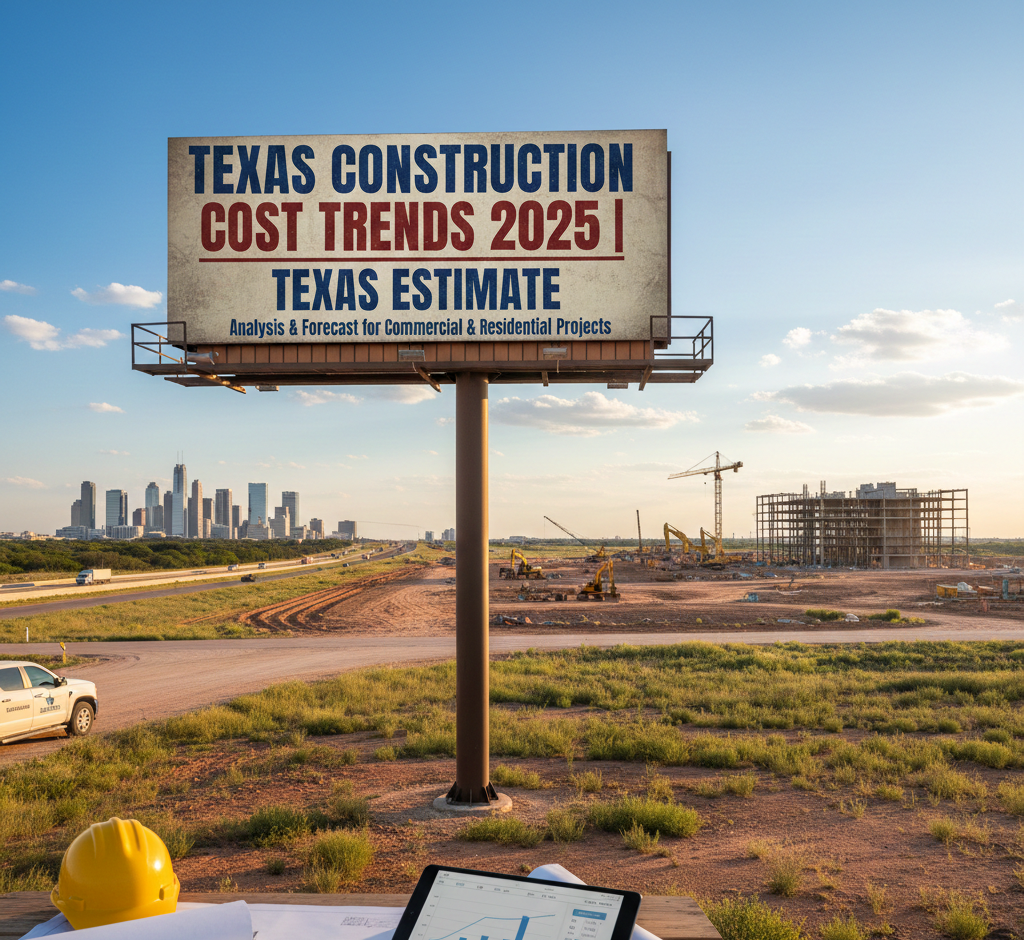

Texas Construction Cost Trends 2025 | Texas Estimate
Construction costs across Texas are projected to rise steadily in 2025, driven by a mix of strong population growth, high demand for new housing, rising labor wages, and continued fluctuations in material prices. Texas remains one of the fastest-growing states in the U.S., and this rapid expansion continues to push construction activity in cities such as Dallas–Fort Worth, Houston, Austin, and San Antonio.
In 2025, builders can expect higher per-square-foot construction costs compared to previous years, especially in residential and light commercial sectors. Material prices—particularly lumber, steel, concrete, and asphalt—are experiencing moderate increases due to supply chain delays and regional demand. Labor costs are also trending upward as contractors across Texas compete for skilled trades.
Despite rising expenses, Texas still offers more cost-efficient construction compared to many coastal states. However, accurate estimating and detailed takeoffs are now more important than ever. At Texas Estimate, we closely track statewide cost movements to help contractors, developers, and homeowners stay ahead of the changing market and plan their 2025 projects with confidence.
Why Tracking Texas Cost Trends Matters for Contractors & Homeowners
Understanding construction cost trends in Texas is essential for budget control, accurate bidding, and project planning. Whether you are a general contractor preparing estimates or a homeowner planning a remodel, staying updated with 2025 price movements can save thousands of dollars and prevent unexpected delays.
For contractors, real-time price awareness leads to competitive yet profitable bids, better labor scheduling, and smarter material purchasing. When you track costs consistently, you can avoid budget overruns, adjust quotes accurately, and secure projects with confidence.
Homeowners also benefit from knowing how Texas-specific cost changes may impact renovation plans, home additions, or new construction. Rising labor rates, seasonal material spikes, and regional price differences can significantly affect the final project budget.
By monitoring Texas construction cost trends—especially through reliable estimating partners like Texas Estimate—you gain the insight needed to start projects at the right time, negotiate better pricing, and make informed decisions for 2025 and beyond.
Key Construction Cost Drivers in Texas (2025)
As Texas continues to experience rapid growth across residential, commercial, and industrial sectors, construction costs in 2025 are being shaped by several powerful market forces. Understanding these cost drivers is essential for accurate budgeting, competitive bidding, and long-term project planning. Here’s a deep look at the biggest factors influencing Texas construction costs in 2025.
Labor Shortages and Wage Increases Across Texas
The Texas construction industry is facing one of the tightest labor markets in decades. Skilled professionals—such as electricians, plumbers, HVAC technicians, and framers—are in high demand but in limited supply.
Several factors are pushing wages upward:
- Rapid growth in major metros like Dallas–Fort Worth, Houston, Austin, and San Antonio
- High demand for industrial and commercial projects
- Retirement of skilled workers without enough new talent entering trades
- Competition between residential and commercial contractors for the same workforce
As a result, construction labor rates in Texas are projected to rise steadily through 2025, increasing overall project costs and extending timelines. Contractors across Texas are adjusting bid estimates to reflect these higher labor expenses.
Material Price Fluctuations: Wood, Concrete, Steel, and More
Material prices continue to be one of the largest cost variables in Texas construction. Although some material costs stabilized in late 2024, many remain elevated due to demand, inflation, and regional market pressures.
Key material trends in Texas for 2025 include:
- Lumber: Prices remain higher than the long-term average due to increased residential construction across Texas suburbs.
- Concrete & Cement: Demand from highway expansions and commercial projects is increasing prices in regions like DFW, Central Texas, and the Gulf Coast.
- Steel & Metals: Industrial and energy-sector growth, especially near Houston and West Texas, is keeping steel prices volatile.
- Mechanical, Electrical & Plumbing (MEP) materials: Continued shortages of copper, PVC, and insulation materials are impacting costs statewide.
These fluctuations mean that accurate, Texas-specific estimating is critical for controlling budget overruns.
Impact of Supply Chain and Logistics Inside Texas
Texas has one of the most complex supply chain environments in the U.S., with major ports, interstate networks, and distribution hubs. Even so, logistics challenges continue to influence construction costs in 2025.
Key logistics factors:
- Port congestion in Houston and Gulf Coast areas impacts delivery timelines for imported materials.
- Long-distance hauling costs are rising, especially on routes between West Texas, Central Texas, and DFW.
- Driver shortages continue to affect transportation pricing and scheduling.
- Fuel price fluctuations are adding unpredictable costs to delivery budgets.
Delays in material deliveries—even by a few days—can significantly increase overall project timelines and labor expenses.
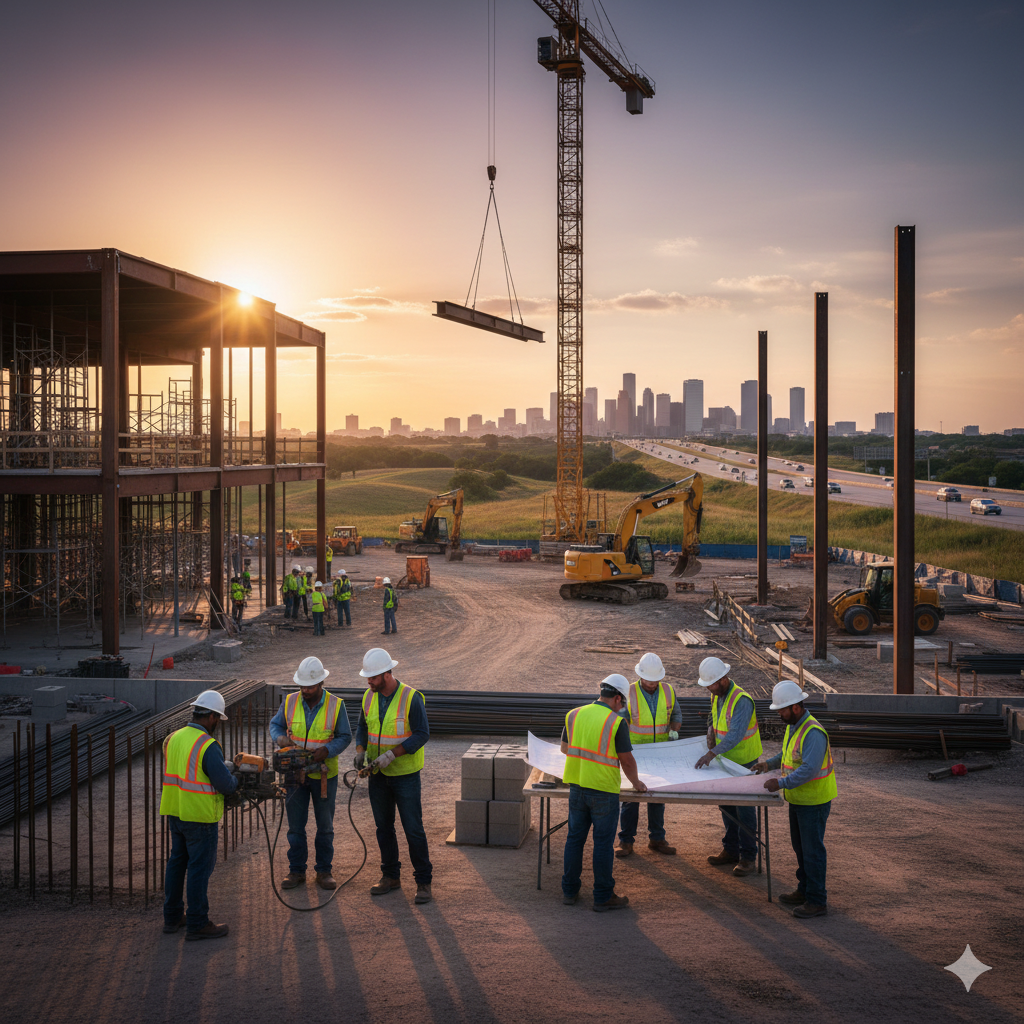
Regional Differences: North, Central, West & South Texas
Texas is geographically massive, and construction costs vary widely by region. In 2025, these differences are becoming even more pronounced.
North Texas (DFW Area)
- High demand for residential and commercial projects
- Increased labor competition and higher wages
- Strong industrial growth driving material shortages
Central Texas (Austin, Round Rock, San Marcos)
- One of the fastest-growing markets in the country
- Elevated land, labor, and material costs
- Technology sector expansion pushing up construction demand
West Texas
- Energy-sector activity affects steel and industrial material pricing
- Larger distances between suppliers lead to higher transportation costs
South Texas (Houston, San Antonio, Corpus Christi)
- Heavy petrochemical and industrial presence impacts material demand
- High humidity and coastal climate influence specialty material pricing
- Strong population growth continues to push residential construction costs upward
These regional variations make localized estimating essential for accurate projections in 2025.
Residential Construction Cost Trends in Texas 2025
Residential construction in Texas continues to grow in 2025, driven by population growth, increased demand for housing, and rising material and labor expenses. Homeowners, builders, and developers across Texas are experiencing cost changes that vary by region, project type, and market conditions. Understanding these trends is essential for accurate budgeting, and that’s where Texas Estimate helps homeowners and contractors make informed decisions.
Average Cost per Square Foot for Texas Homes
In 2025, the average residential construction cost per square foot in Texas shows a noticeable upward trend due to material inflation, skilled labor shortages, and rapid urban development.
- Standard Home Construction: $145 – $210 per sq ft (statewide average)
- Mid-Range Builds: $185 – $250 per sq ft
- High-End Custom Homes: $250 – $400+ per sq ft depending on finishes and location
Key factors influencing cost-per-square-foot in Texas 2025:
- Rising cost of concrete, lumber, and structural steel
- Higher demand in fast-growing metros like Austin and DFW
- Increased labor rates for electricians, plumbers, and framing crews
- Energy-efficient building requirements in several Texas cities
For accurate project budgeting, Texas Estimate provides detailed material takeoffs and labor cost assessments tailored to your city and home type.
New Home Construction vs. Renovation Trends
Both new home construction and renovation projects are on the rise in Texas in 2025, but each follows its own cost behavior.
New Home Construction Trends
New builds remain popular due to population growth, especially in Central Texas, DFW, and Greater Houston.
Cost drivers include:
- Land prices rising near major metros
- Material shortages for roofing, drywall, and MEP systems
- Higher wages across Texas trades
- Increased demand for energy-efficient and smart home features
New home construction costs are growing anywhere from 6%–12% year-over-year, depending on the region.
Renovation Trends
Renovation activity is growing even faster because many homeowners prefer upgrading instead of buying new due to rising mortgage rates.
Popular renovation categories with cost increases:
- Kitchen and bath remodels
- Home additions and ADUs
- Roof replacement & exterior work
- Structural repairs from Texas weather events
Renovation costs in Texas increased 8%–15% due to limited contractor availability and high demand.
Whether building new or renovating, Texas Estimate offers accurate cost insights so you can manage budget expectations in 2025.
Texas Cities with the Fastest Rising Residential Costs (2025)
While costs are increasing statewide, certain Texas cities are experiencing faster residential construction inflation in 2025.
1. Austin, TX
- One of the highest increases in Texas
- Rising land prices, tech-driven population growth
- Labor shortages increasing framing and electrical costs
2. Dallas–Fort Worth (DFW)
- Strong demand for suburban housing
- Rapid development in Frisco, McKinney, and Denton
- Material and labor costs rising steadily
3. Houston, TX
- Large residential expansion across suburbs like Katy and Cypress
- Higher cost of MEP trades due to energy-sector competition
4. San Antonio, TX
- Moderate but consistent increases
- Rising demand for new subdivisions and multi-family housing
5. El Paso & Lubbock
- Faster growth compared to previous years
- Increased cost in concrete, roofing, and framing materials
These rapid-growth markets experience higher cost-per-square-foot trends compared to rural and West Texas regions.
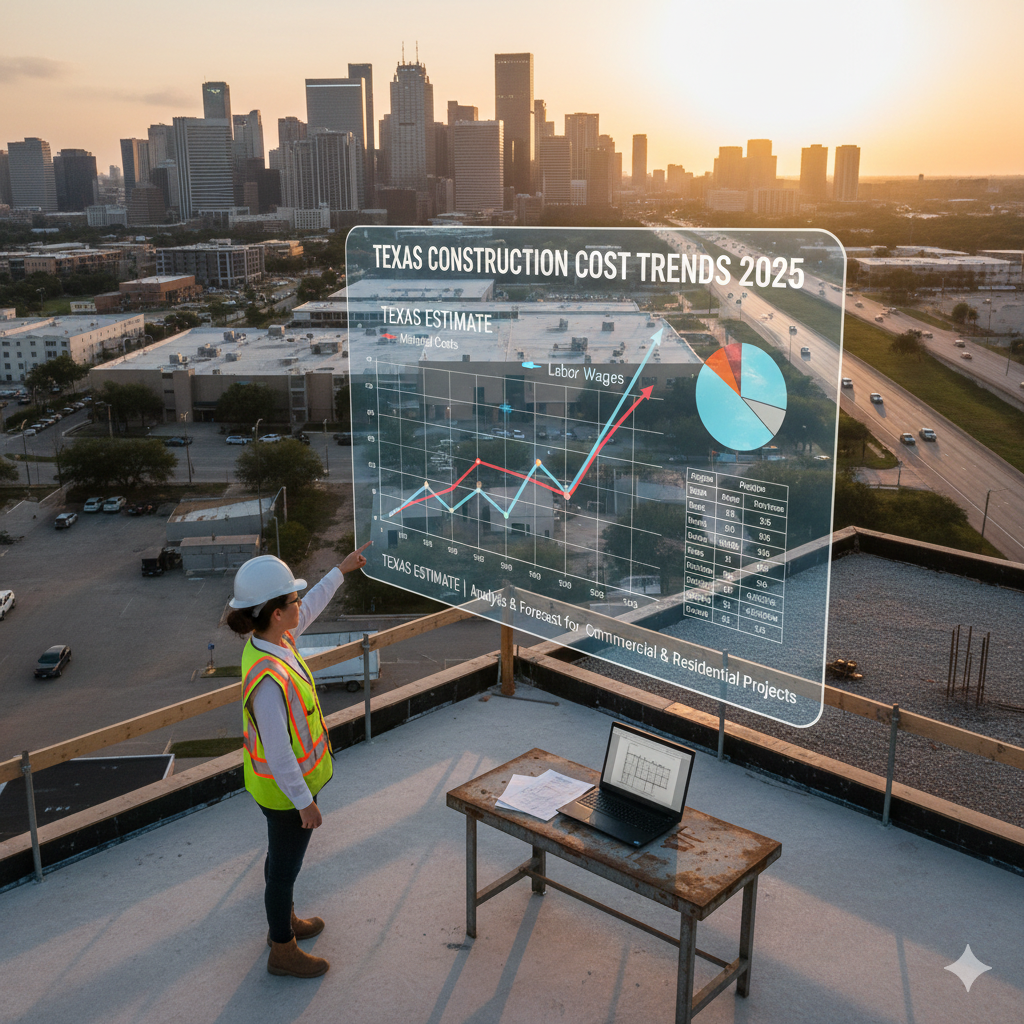
Commercial Construction Cost Trends in Texas 2025
Commercial construction costs in Texas continue to rise in 2025 due to strong economic demand, rapid population growth, and labor shortages across the state. Major markets including Dallas–Fort Worth, Houston, Austin, San Antonio, and Central Texas are seeing the highest increases. At Texas Estimate, we closely monitor these trends to help contractors, developers, and investors stay ahead of cost fluctuations.
Rising Costs in Industrial, Retail, and Office Projects
Texas remains one of the fastest-growing commercial hubs in the U.S., especially for industrial warehouses, logistics centers, data facilities, retail buildings, and modern office spaces. In 2025, several factors are pushing these project costs upward:
- Industrial building costs have increased statewide, driven by high demand for distribution centers and manufacturing facilities.
- Retail construction costs continue rising, especially in high-traffic zones of Houston, Austin, and DFW where land values and labor rates are climbing.
- Office construction is seeing moderate but steady cost escalation due to premium material pricing, sustainable building requirements, and advanced MEP systems.
Across Texas, the cost per square foot for commercial projects is higher than 2024, with steel, concrete, roofing systems, and electrical components experiencing the largest price jumps. Developers are prioritizing accurate cost estimates to maintain profitability in a competitive market—making precise forecasting from Texas Estimate more essential than ever.
Infrastructure & Public Project Cost Trends
Texas infrastructure spending continues to expand, with 2025 showing strong activity in:
- Highway and transportation expansion projects
- Water, sewer, and utility upgrades
- Public school construction and renovation
- Municipal and government facility development
These public and infrastructure projects face unique cost challenges:
- Heavy equipment and fuel costs remain elevated.
- Concrete, asphalt, and aggregate prices are trending upward.
- Skilled labor shortages—especially in civil and highway construction—continue to push wages higher.
Cities like Houston, Austin, and San Antonio report some of the highest infrastructure cost increases due to population growth and ongoing mega-projects. Contractors rely on detailed takeoffs to avoid budget overruns, and Texas Estimate provides accurate civil and infrastructure estimating services tailored to these rising market conditions.
Energy Sector Impact on Texas Construction Costs
As the nation’s leading energy-producing state, Texas is heavily influenced by changes in the oil, gas, and renewable energy industries. In 2025, these sectors are directly affecting commercial construction pricing:
- Oil & gas facility development across West Texas and the Gulf Coast is driving demand for steel, mechanical systems, and industrial labor.
- Renewable energy projects, especially solar and wind, are increasing the need for electrical components and specialized contractors.
- Fluctuations in energy prices impact material transportation costs, fuel expenses, and equipment operation costs across all commercial projects.
Energy-sector growth boosts the overall construction economy, but it also leads to labor competition—pushing wages higher in markets like Midland–Odessa, Corpus Christi, and the Houston Ship Channel. This creates a ripple effect on commercial construction pricing statewide.
With these complex cost pressures, businesses and contractors benefit from accurate cost projections provided by Texas Estimate, ensuring they stay competitive in a rapidly shifting Texas construction market.
Material Cost Forecast for 2025
Lumber Cost Forecast in Texas
Lumber prices in Texas are expected to remain moderately elevated in 2025 due to ongoing demand in the residential market—especially in fast-growing metros like Dallas–Fort Worth, Austin, Houston, and San Antonio. Although the extreme volatility seen in previous years has stabilized, contractors can still expect 5–8% higher lumber prices compared to early 2024 levels.
In Texas, single-family builds continue to dominate the market, which keeps framing lumber, plywood, and treated wood in strong demand. Builders should anticipate seasonal spikes in spring and summer, when most new projects break ground.
For more accurate budgeting, Texas Estimate helps clients track local supplier pricing, ensuring realistic cost projections for framing packages and wood-based finishes.
Concrete & Cement Cost Outlook
Concrete and cement costs in Texas have been rising steadily due to increased demand from infrastructure improvements, highway expansions, industrial projects, and rapid urban growth. In 2025, the state is projected to see a 3–7% increase in concrete pricing, driven by higher fuel rates, regional sand & aggregate shortages, and transport expenses.
Urban regions like Houston and Austin—where large commercial developments and tech-sector infrastructure are booming—are likely to experience the sharpest increases.
Contractors should also anticipate longer lead times during peak construction months. Texas Estimate offers detailed concrete quantity takeoffs to help project owners control cost overruns before pouring begins.
Steel & Metal Pricing Projections
Steel, rebar, and structural metal prices in Texas are expected to experience mild to moderate increases in 2025. The energy sector—especially oil & gas revival in West Texas and Gulf Coast petrochemical expansions—drives much of the demand.
With global supply chains stabilizing but U.S. manufacturing costs rising, Texas builders can expect structural steel, rebar, and metal panels to increase around 4–9% throughout the year.
Industrial, warehouse, and commercial projects will feel this impact the most.
Texas Estimate provides updated steel takeoff reports so contractors can lock in pricing early and avoid unexpected fluctuations during the procurement stage.
MEP (Mechanical, Electrical, Plumbing) Material Trend
MEP materials continue to be some of the fastest-rising cost categories in Texas. Copper wiring, PVC, HVAC equipment, ducting, and plumbing fixtures are projected to rise 6–10% in 2025, driven by manufacturing cost increases and equipment shortages.
Texas’ extreme weather conditions also create consistent demand for upgraded HVAC systems, boosting the price of air-handling units and refrigerant components.
Electrical materials remain sensitive to copper market changes, while plumbing materials like PEX and PVC may see localized increases depending on Texas regional supply.
To help owners and contractors stay within budget, Texas Estimate prepares precise MEP takeoffs with updated material pricing based on local Texas distributors and suppliers.
Texas Labor Market Forecast for 2025
Skilled Labor Shortage & Wage Growth
Texas is expected to face a continued skilled labor shortage in 2025, especially in rapidly developing regions like Dallas–Fort Worth, Houston, Austin, and San Antonio. As major residential and commercial projects expand, the demand for qualified labor is outpacing supply.
Contractors across Texas are reporting challenges in hiring experienced framers, concrete workers, roofers, electricians, and plumbers. This shortage is pushing hourly wages higher, with some trades seeing 5%–12% wage increases compared to the previous year.
The competition among builders is becoming stronger, meaning higher labor bids and longer project lead times. For owners and developers, this directly translates into increased construction budgets and potential delays if labor is not secured early.
High-Demand Trades in 2025 (Electricians, Plumbers, Framers, etc.)
In 2025, several trades will continue to be highly in demand across Texas, driven by large-scale infrastructure upgrades, residential growth, and commercial expansions:
- Electricians – Major growth in EV charging infrastructure, warehouse construction, and new home developments keeps electricians among the highest-demand trades.
- Plumbers – Texas cities experiencing rapid population growth need more plumbing installations for residential communities, hospitals, and commercial buildings.
- Framers & Carpenters – Residential housing expansion in areas like Central Texas and the Gulf Coast significantly increases framing demand.
- HVAC Technicians – Hot Texas climate and new energy-efficient systems drive demand for skilled HVAC installers.
- Concrete & Foundation Workers – Ongoing highway and industrial projects keep concrete labor costs elevated.
Because these trades are essential for almost every construction phase, their limited availability significantly impacts construction timelines and cost forecasting throughout Texas.
How Labor Trends Will Impact Project Budgets
The 2025 Texas labor market conditions will directly influence construction cost trends across the state. As wages rise and skilled workers remain limited, builders can expect:
- Higher overall project bids from subcontractors
- Longer project durations due to limited crew availability
- Increased labor premiums for accelerated schedules
- Greater competition for skilled teams, especially in major metros
- Cost overruns if labor is not planned early
For contractors, developers, and homeowners, accurate labor forecasting is essential. Labor often makes up 35%–50% of total project cost, so even minor wage increases can significantly affect the final budget.
At Texas Estimate, we help clients anticipate these labor-driven increases by providing precise takeoffs, updated labor pricing, and project-specific cost projections for 2025. With reliable estimating, you can avoid unexpected budget jumps and stay competitive in the Texas market.

Cost Variations Across Major Texas Cities
Construction costs in Texas vary widely by region due to differences in labor availability, material demand, growth pace, and market competition. In 2025, these variations become even more noticeable across major Texas cities. Contractors, builders, and homeowners must understand these regional trends to budget accurately and avoid project delays. Below is a detailed breakdown of the most important Texas markets.
Dallas–Fort Worth Construction Cost Trends
The Dallas–Fort Worth metroplex continues to experience steady construction growth in 2025. DFW’s strong commercial market, tech expansion, and rising suburban developments are pushing costs upward.
Key 2025 Trends in DFW:
- Labor rates continue rising, especially for electricians, HVAC technicians, and finish carpenters.
- Material demand is high due to rapid residential expansion in cities like Frisco, McKinney, and Arlington.
- Commercial construction costs are climbing, driven by warehouse, industrial, and mixed-use projects.
- Average project costs in DFW remain slightly above the Texas state average, especially for commercial builds.
Overall, DFW remains one of the most competitive and cost-dynamic construction markets in Texas for 2025.
Houston Market Cost Trends for 2025
Houston’s construction costs in 2025 are shaped by its energy sector, port-related material flow, and rapid population growth.
Key 2025 Trends in Houston:
- Material prices are fluctuating, especially steel, concrete, and mechanical items due to high industrial demand.
- Labor shortages continue, with higher wages in piping, welding, and MEP trades.
- Residential construction costs are rising in fast-growing suburbs like Katy, Cypress, and Pearland.
- Commercial costs remain competitive, but large industrial projects create pressure on skilled labor availability.
Houston remains a high-demand construction hub, especially for industrial, petrochemical, and multifamily projects.
Austin’s Rapid Growth & Rising Building Costs
Austin is currently Texas’s fastest-rising market in terms of construction costs. Its rapid population growth, influx of tech companies, and shortage of skilled labor continue to push prices upward in 2025.
Key 2025 Trends in Austin:
- Labor costs are among the highest in Texas due to intense competition for skilled workers.
- Material prices trend higher, especially for drywall, electrical materials, and high-end finishes.
- Residential construction shows the fastest cost escalation, especially in areas like Round Rock, Leander, and Cedar Park.
- Commercial development, especially office and tech facilities, adds pressure on both labor and material supply.
Austin remains the most expensive city in Texas to build in, with continued growth driving 2025 pricing upward.
San Antonio’s 2025 Cost Expectations
San Antonio remains one of the more affordable construction markets in Texas, but costs are increasing steadily in 2025 due to population growth and infrastructure upgrades.
Key 2025 Trends in San Antonio:
- Labor availability is better than in Austin or DFW, keeping rates moderate but rising.
- Residential project costs continue to grow as demand increases in suburbs like Stone Oak, Alamo Ranch, and New Braunfels.
- Commercial construction remains stable, with lower overall costs compared to other major Texas metros.
- Material costs remain close to the Texas average due to strong supply access.
San Antonio offers better cost stability, making it attractive for budget-conscious projects in 2025.
El Paso, Lubbock & Other Emerging Markets
Emerging Texas markets such as El Paso, Lubbock, Waco, Amarillo, Midland, and McAllen are showing noticeable growth in 2025, leading to moderate cost increases.
Key 2025 Trends in Emerging Markets:
- Labor shortages are moderate, but certain trades remain limited.
- Material costs rise slightly, especially in regions farther from major supply centers.
- Residential development is increasing steadily, driving demand for framers, painters, and concrete crews.
- Commercial growth is moderate, with lower overall construction costs compared to major Texas metros.
- Infrastructure and public projects in El Paso and Midland are adding pressure to local labor markets.
These emerging regions remain cost-effective alternatives to large metropolitan areas while still experiencing steady 2025 growth.
Technology & Its Role in Reducing Costs
AI, Estimating Software & Digital Takeoffs
Technology is reshaping how contractors manage project costs across Texas. In 2025, AI-powered estimating tools and digital takeoff software are helping builders eliminate guesswork, reduce waste, and speed up the preconstruction phase.
Texas-based contractors—especially in Dallas–Fort Worth, Houston, Austin, and San Antonio—are adopting AI estimating solutions to reduce manual errors and get faster, more accurate quantity takeoffs. Platforms that analyze drawings automatically can cut estimating time by up to 50%, allowing contractors to bid more jobs without increasing workload.
At Texas Estimate, we use advanced digital takeoff tools to deliver precise material quantities, labor projections, and cost breakdowns tailored to Texas construction markets. This helps builders stay competitive despite rising material and labor costs across the state.
Prefab & Modular Construction Growth in Texas
Prefab and modular construction are becoming major cost-saving trends in Texas for 2025. With the state facing ongoing labor shortages and high demand for quick project delivery, modular building offers faster timelines, reduced waste, and more predictable budgets.
Cities like Austin and Houston, where speed-to-market is critical, are seeing rapid adoption of prefab components for residential, multifamily, commercial, and industrial projects. Manufacturing components in controlled environments reduces labor requirements on-site and minimizes delays caused by Texas weather—especially heat waves, rainfall, and storm seasons.
For contractors focused on cost efficiency, modular construction lowers labor hours, improves material usage, and shortens overall project duration, making it a strong strategy for controlling rising construction costs in Texas.
Sustainable Construction & Green Building Impact
Sustainable construction is no longer optional in Texas—it’s becoming a major cost trend as the state pushes for energy-efficient buildings and long-term value. Green building practices, including energy-saving HVAC systems, insulated materials, low-waste framing techniques, and solar integration, can reduce lifetime building costs significantly.
Many Texas cities—including Austin, Houston, and San Antonio—offer incentives for energy-efficient construction, helping offset initial costs. Builders are increasingly using recycled materials, smart energy systems, and environmentally friendly building products to achieve LEED certifications and meet new state and city-level efficiency standards.
For 2025, the shift toward sustainable construction helps reduce long-term operating costs, improves property value, and aligns with Texas’s growing demand for eco-friendly development. At Texas Estimate, we incorporate green materials and energy-efficient product pricing into our estimating models to help contractors plan for both upfront and lifetime savings.
2025 Cost-Saving Tips for Texas Builders & Homeowners
Managing rising construction costs in Texas is becoming more challenging each year, especially with demand increasing in fast-growing areas like Dallas–Fort Worth, Austin, Houston, and San Antonio. In 2025, smart budgeting, accurate estimates, and strategic planning will play a major role in controlling project expenses. Whether you’re a homeowner starting a remodel or a contractor handling large-scale builds, the right strategies can save thousands.
Best Practices to Control Rising Costs
1. Lock Material Prices Early
Material costs across Texas—especially lumber, concrete, and steel—are expected to fluctuate in 2025. Securing quotes in advance and purchasing key materials early can protect you from mid-project price hikes.
2. Work With Local Texas Suppliers
Texas-based vendors often provide better pricing, faster delivery, and more reliable availability. Local sourcing also reduces transportation fees, which continue to rise across long distances.
3. Choose Cost-Efficient Designs and Methods
Opt for simplified floor plans, open layouts, modular components, and standardized materials. These design choices reduce labor hours and material waste—two major cost drivers in Texas projects.
4. Plan for Permits & Code Requirements
Texas cities have different permit timelines and fees. Accounting for these early helps avoid delays and unexpected expenses, especially in cities like Austin where permit times are longer.
5. Manage Labor Efficiently
Labor shortages continue in Texas, particularly in skilled trades. Scheduling crews ahead, avoiding last-minute hiring, and preventing rework through detailed planning can dramatically reduce labor costs.
How Accurate Estimating Prevents Budget Overruns
Accurate estimating is the foundation of every successful construction project. In a high-growth market like Texas, unpredictable price changes can easily push a project over budget. A precise estimate helps:
• Avoid hidden or unexpected expenses
From framing to MEP, an accurate takeoff ensures all materials and labor needs are calculated before work begins.
• Improve cash flow and project planning
Knowing exact quantities and real Texas market rates allows builders and homeowners to allocate funds with confidence.
• Reduce change orders and delays
Most project overruns in Texas happen due to unclear scopes or underestimated material quantities. A detailed estimate eliminates guesswork.
• Compare multiple contractor quotes fairly
With a professional estimate from Texas Estimate, homeowners can ensure bids are aligned and priced correctly.
Accurate estimating is not just about numbers—it’s a strategy that keeps your project on track, on time, and within budget.
When to Start a Project for Best Savings in 2025
Timing plays a major role in managing construction costs in Texas. Here’s how to get the best value in 2025:
• Start in Early Q2 (March–May)
This period avoids the high prices and labor shortages of peak summer months. Material availability is also stronger in spring.
• Avoid Late Summer Heat
July–September is the most expensive time to build in Texas due to extreme weather, slowed work productivity, and increased demand for skilled labor.
• Begin Planning 2–3 Months Before You Build
With early planning, you can lock in material pricing, book crews at better rates, and avoid rushed decisions.
• Winter Projects (December–February) Can Save Money
Off-season demand is lower, meaning more flexible labor scheduling and better contractor pricing—especially in North and West Texas.

Why Choose Texas Estimate for Accurate Cost Forecasting
Our Expertise in Texas Construction Estimating
At Texas Estimate, we specialize in providing accurate construction cost forecasting tailored specifically for Texas. With years of experience in the Lone Star State, we understand the unique factors that influence construction costs across Texas cities—from Houston’s booming residential market to Austin’s rapid commercial growth. Our team stays updated with the latest Texas construction cost trends for 2025, ensuring every estimate reflects regional labor rates, material price fluctuations, and local regulations.
Detailed Takeoffs for Residential & Commercial Projects
We provide comprehensive takeoffs for both residential and commercial projects throughout Texas. Our estimates break down costs for every stage of construction, including materials, labor, equipment, and overheads. Whether you are building a new home in San Antonio or developing a commercial property in Dallas, our detailed takeoffs allow contractors, builders, and homeowners to budget accurately and plan efficiently.
How Texas Estimate Helps Reduce Cost Uncertainty
Construction costs in Texas are rising, and unpredictability can significantly impact project budgets. At Texas Estimate, we help reduce cost uncertainty by combining real-time market data, historical trends, and localized analysis. By leveraging our expertise, Texas builders and property owners can make informed decisions, avoid costly overruns, and stay ahead in 2025’s dynamic construction market.
Conclusion: Final Thoughts on Texas Construction Costs in 2025
As we look ahead to 2025, construction costs in Texas are expected to continue evolving due to factors like rising material prices, labor shortages, and regional demand variations. Cities like Austin, Dallas-Fort Worth, and Houston are likely to see higher cost pressures, while emerging markets such as San Antonio, El Paso, and Lubbock may offer more competitive pricing.
Understanding these trends is crucial for both homeowners planning renovations and contractors managing commercial or residential projects. Accurate forecasting and cost estimating can help prevent budget overruns and ensure projects are completed on time and within budget. At Texas Estimate, we provide precise cost analysis and detailed takeoffs to help builders and homeowners make informed decisions in the Texas construction market.
How Builders Can Stay Ahead of the Trend
- Leverage Accurate Cost Estimating Tools
Builders in Texas can stay competitive by using advanced estimating software and digital takeoffs. These tools help forecast project costs more accurately, accounting for regional price variations in materials and labor. - Plan Projects Strategically
Timing plays a key role. Starting projects when material prices stabilize and labor is more available can significantly reduce costs. Staying informed about city-specific trends in Texas ensures smarter project scheduling. - Optimize Material Procurement
With fluctuating costs of lumber, concrete, and steel, securing materials in bulk or from local Texas suppliers can save money and reduce delays. - Invest in Skilled Labor
Texas faces a shortage of skilled tradespeople, so retaining experienced staff and offering competitive wages ensures projects maintain quality while avoiding costly delays. - Adopt Technology & Modern Construction Methods
Implementing prefabrication, modular construction, and green building practices can streamline operations and reduce waste, keeping Texas construction projects both cost-efficient and sustainable. - Partner with Trusted Estimating Services
Using services like Texas Estimate provides reliable cost forecasting, enabling builders to plan accurately, bid competitively, and stay ahead in the Texas construction market.